
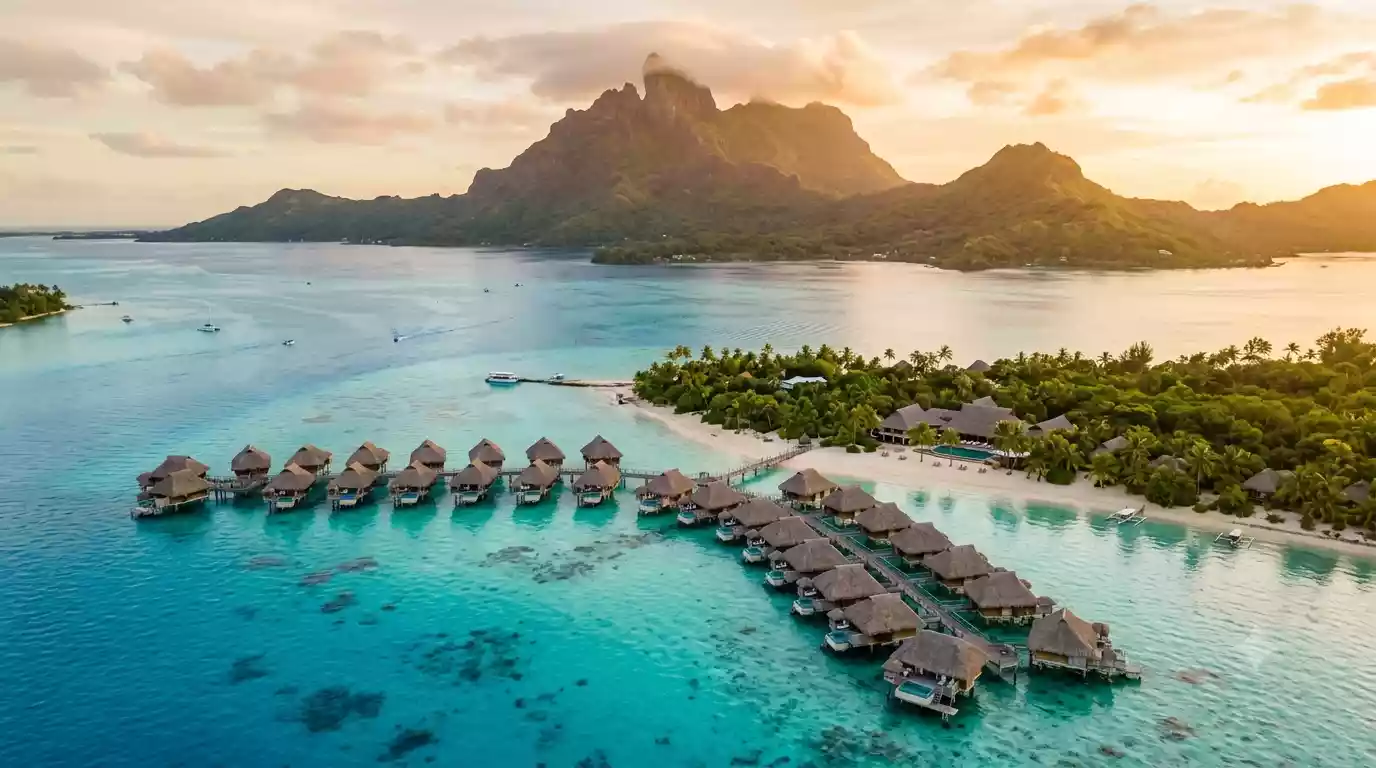
There is a version of this article I almost wrote instead.
It would have started with Mount Otemanu at sunrise, gone straight into the turquoise lagoon, spent three paragraphs on the overwater bungalow deck, and ended with something like “if you only do one luxury trip in your life, make it this one.”
That version would have been easier to write. It also would have been useless to you.
Because the real question — the one that was open on seventeen browser tabs at two in the morning before the booking was made — is not whether Four Seasons Resort Bora Bora is beautiful. It obviously is. The question is whether it earns what it costs. Whether the experience is genuinely transformative or just extremely photogenic. Whether the people who spend this kind of money on four nights in French Polynesia come back thinking it was the right decision, or whether they sit on that overwater deck calculating what else they could have done with the same budget.
That is what this review is actually about.
First: Why Bora Bora at All?
Before getting to the Four Seasons specifically, it is worth understanding what makes Bora Bora different from every other overwater bungalow destination — because the distinction matters when you’re trying to decide if this particular trip is right for you.
The Maldives is the global benchmark for overwater luxury. The reef is more consistently pristine. The water clarity is exceptional. The atolls are flat and low-lying, which means nothing interrupts the horizon from your deck — just water and sky, in every direction, forever. If marine biodiversity and seascape purity are your priority, the Maldives wins. We covered this comparison in depth in our guide to the best overwater bungalows in the world.
But Bora Bora has something the Maldives cannot manufacture: Mount Otemanu.
The extinct volcano rises 727 meters from the center of the island, its dark basalt peak draped in clouds most mornings, its lower slopes green and dramatic above the lagoon. It changes color with the light — charcoal at dawn, deep green by mid-morning, then burnished orange and violet as the sun sets over the Pacific. Every photograph from every overwater bungalow in Bora Bora has that mountain in the background, and no amount of looking at photographs actually prepares you for what it does to the atmosphere of being there.
That mountain is the reason people choose Bora Bora over the Maldives. Not the reef — the landscape. And Four Seasons understood that when they chose where to position their villas.
The Resort: What You’re Actually Arriving Into
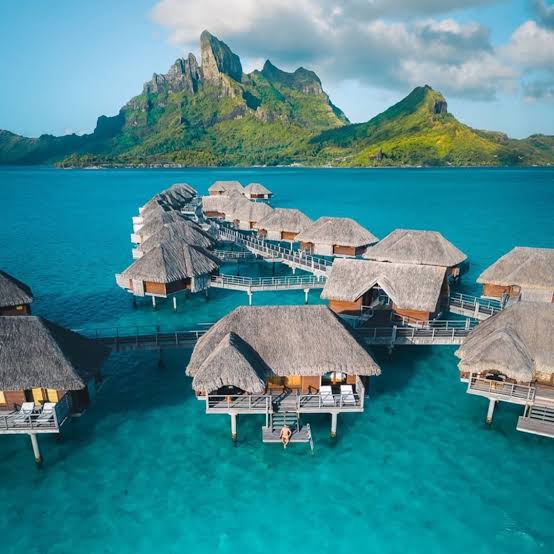
Four Seasons Resort Bora Bora sits on a small motu — a flat coral islet — on the edge of the main lagoon, separated from the main island by water. Arrival is by boat from the airport on Motu Mute, and that transfer, which takes around 30 minutes, is not incidental. It is the first act of the resort’s deliberate decompression. By the time the boat docks at the resort’s jetty, with the lagoon extending in every direction and Otemanu visible across the water, something has already shifted.
Check-in doesn’t happen at a desk. It happens in your villa, with a glass of something cold and a staff member who already knows your name. This is not unusual at top-tier luxury resorts, but Four Seasons executes it with a precision that makes it feel less like a procedure and more like an arrival at a house where someone was expecting you.
The resort has 100 bungalows and villas in total. That number matters — it’s large enough to sustain the range of restaurants and facilities that make the property genuinely self-sufficient, but not so large that you ever feel like one of a crowd. After the first day, you stop noticing other guests almost entirely.
The Overwater Bungalows: An Honest Room Report
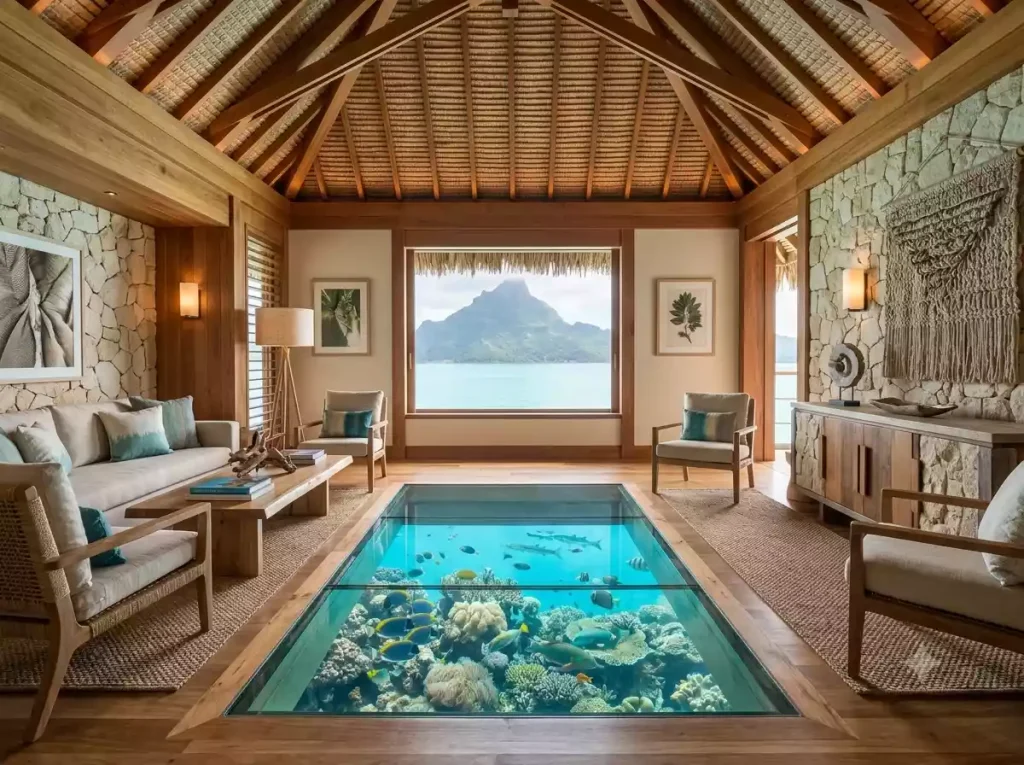
The overwater bungalows at Four Seasons Bora Bora are, genuinely, among the most considered room designs in the South Pacific. The interiors use natural materials throughout — stone, wood, woven textured panels — in a way that complements rather than ignores the surroundings. There is no marble-and-chrome aesthetic here. The design reads as serious without being austere, and comfortable without being soft.
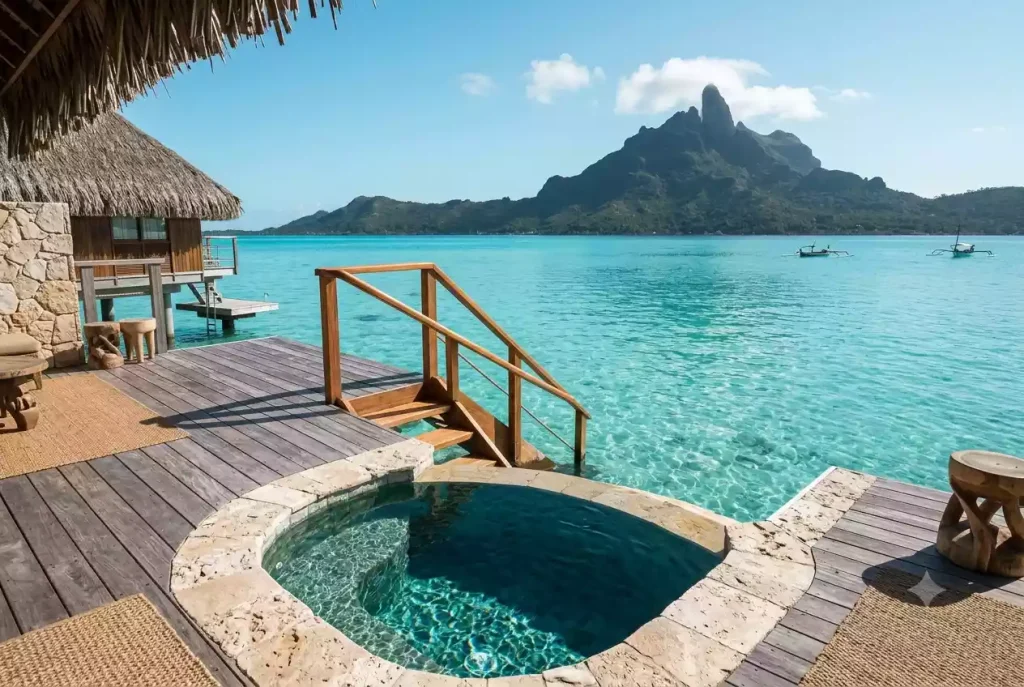
Each bungalow features a private plunge pool on the deck, which is where most guests spend the majority of their daylight hours. The pool is small by villa standards — not designed for swimming laps — but positioned precisely so that the water and the pool become visually continuous, blurring the boundary between what you built and what was already there. The glass floor panel in the living area looks down onto the reef below. Depending on which bungalow you occupy and what the tide is doing, you will see different things through that panel at different times of day.
The staircase from the deck into the lagoon is where the experience either justifies itself or it doesn’t. At Four Seasons, the lagoon entry here is excellent. The water clarity is good. The reef beneath and immediately around the bungalows has been well-maintained, and snorkeling directly from your own staircase — without an organized excursion, without a guide, just stepping off your deck at 7am into water where blacktip reef sharks are moving through the shallows — is an experience that makes it very clear why people come back to this specific category of accommodation.
Some honest notes that most reviews skip over:
- The overwater bungalows are positioned close enough together that early-morning noise from neighboring guests carries across the water. The resort is not silent. If complete isolation is your expectation, look at the Beach Villas or the larger overwater suites at the far ends of the pier.
- The plunge pools heat up significantly in direct sun. By early afternoon, the pool temperature on a clear day can become uncomfortably warm rather than refreshing. The lagoon remains cool throughout.
- Air conditioning in the bungalows works extremely well, which matters more than it sounds — Bora Bora’s humidity, particularly from November to April, is substantial.
- The bungalow interiors, beautiful as they are, are not particularly spacious by the standards of Maldivian overwater villas at comparable price points. The experience is the deck and the water, not the room.
Mount Otemanu: The Thing the Brochure Gets Right
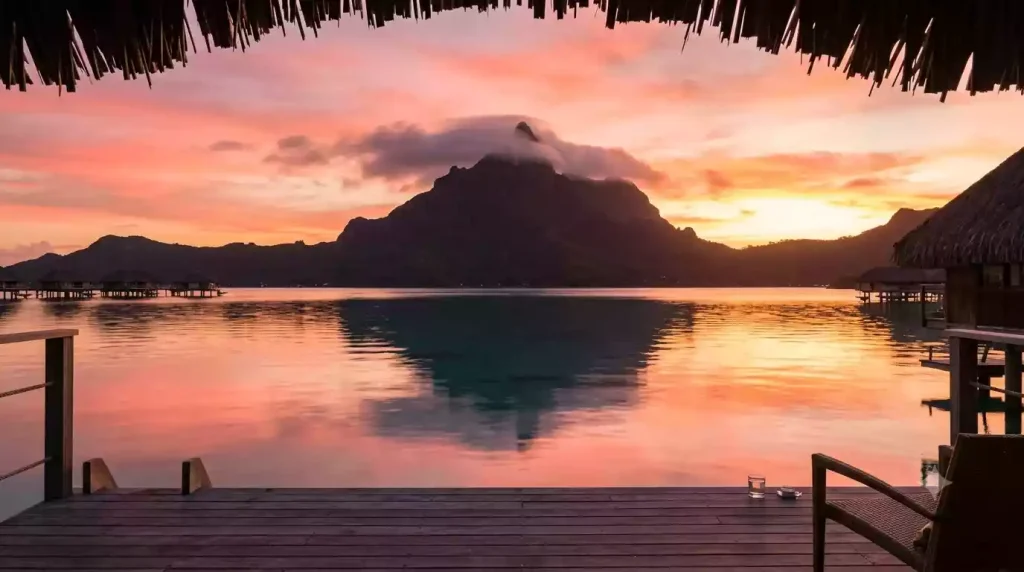
Every Four Seasons Bora Bora photograph features Mount Otemanu, which makes it easy to assume the mountain is more backdrop than experience — something you get used to and stop seeing after the first day.
That assumption is wrong.
The mountain’s presence changes the quality of light at the resort in ways that are not subtle. It catches clouds that nowhere else on the motu catches. On mornings when cloud cover sits low on the peak and the lagoon is flat and glassy, the whole scene acquires a quality that is less postcard and more ancient — the kind of landscape that makes you understand why Polynesian navigators assigned spiritual significance to specific islands and specific mountains.
You May Also Like

Sunrise from an east-facing bungalow deck, with the mountain to the west still dark against a sky that is turning orange and pink behind it, is the moment that appears most frequently in long-form guest reviews — not the pool, not the restaurant, not the service. The mountain at the moment the light changes. That is the experience that visitors report being least prepared for and most affected by.
If you are choosing between bungalow categories, orient your decision around Otemanu views. The premium for a direct mountain-facing position is worth it.
The Service: What “Four Seasons” Actually Means Here
Four Seasons as a brand carries enormous expectations, and the Bora Bora property generally meets them — but it is worth being specific about what that means in practice, because “exceptional service” is a phrase that has been emptied of meaning by overuse.
What distinguishes Four Seasons Bora Bora’s service is not abundance — it is calibration. Staff interactions are warm without being performatively enthusiastic. Requests are fulfilled without the slight delay that signals a system working exactly as it should but no faster. Preferences noted on day one appear in your experience on day three without being referenced, which is the correct way to use information — silently, in service of the guest rather than to demonstrate that you were paying attention.
The butler program here is less structured than the “Mr. Friday” system at Gili Lankanfushi or the full personal-assistant model at some Maldivian properties. Four Seasons Bora Bora operates more as a traditional luxury hotel — extremely high baseline, responsive to requests, attentive to detail — rather than as a resort built around a proactive personal-host concept. For guests who prefer to be left to their own rhythm, this is the right balance. For guests who want a staff member anticipating their every move, it may feel slightly reactive by comparison.
The one area where the service is genuinely exceptional without qualification: the beach and pool team. They are present without being intrusive, and the timing of towel replacement, drink refresh, and sun umbrella adjustment throughout a full day at the resort operates with a precision that becomes noticeable precisely because you never feel attended to — only cared for.
Eating and Drinking at Four Seasons Bora Bora
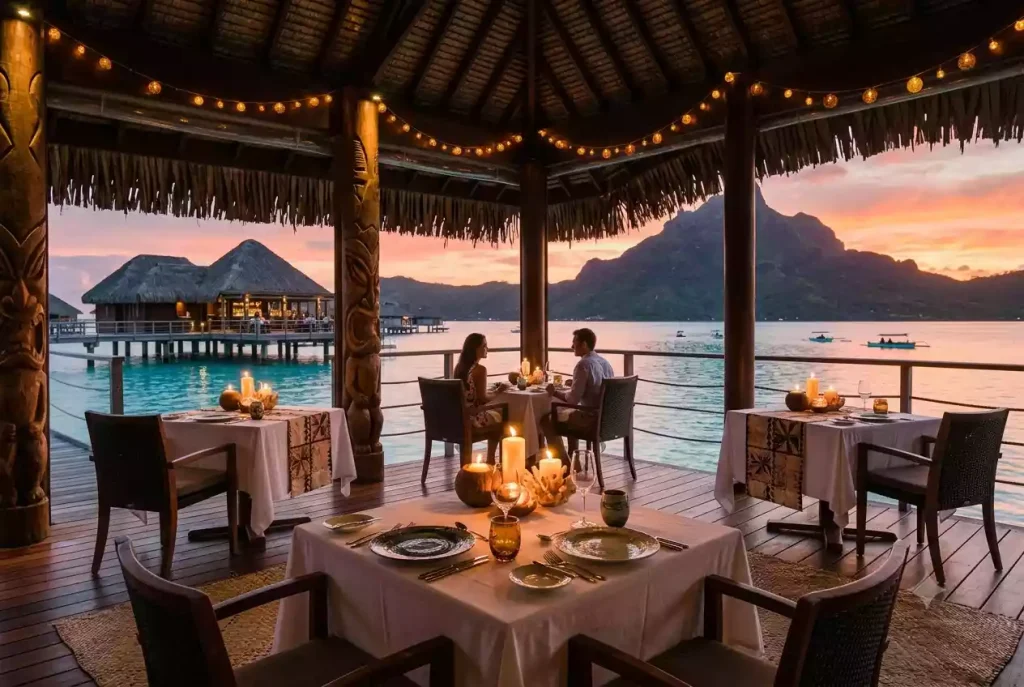
The dining program here is a significant part of the value proposition, particularly on longer stays when you start to feel the constraints of being on a small motu with a finite number of options.
Taravana Grill is the resort’s main restaurant — open-air, positioned over the water, serving a menu of Polynesian-influenced food alongside international standards. The quality is consistently high. The grilled fish, sourced locally, is exceptional. The wine list is extensive and correctly priced for a remote Pacific island, which is to say expensive but not aggressively so relative to the market.
Fare Hoa is the casual poolside option, handling everything from breakfast through to afternoon drinks and light meals. The breakfast here — particularly the fresh tropical fruit, which in Bora Bora has a quality that supermarket produce cannot approximate — is one of the most pleasant routines the resort offers.
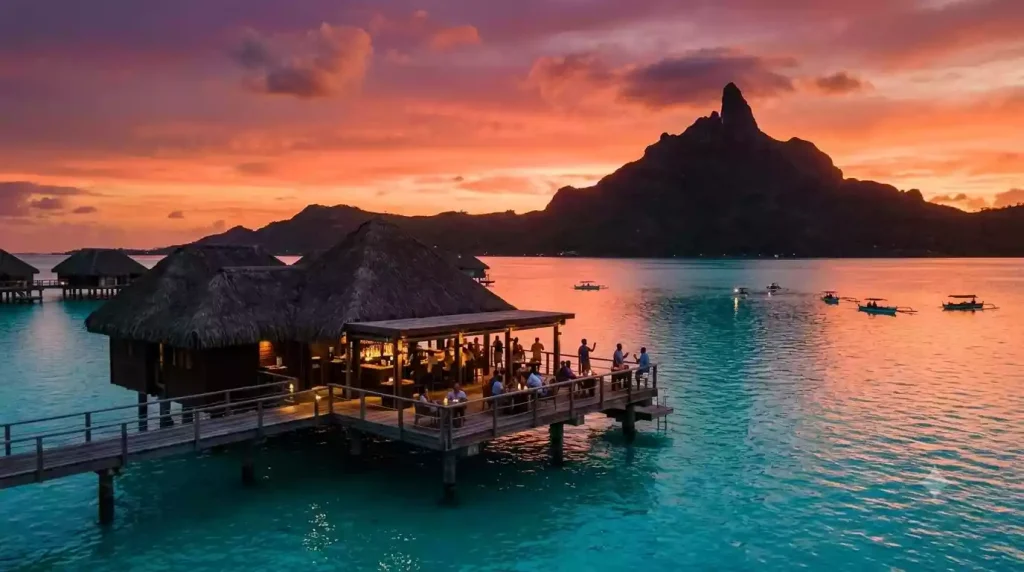
AVI Bar is the overwater bar, and this is where the resort’s relationship with its surroundings becomes most apparent. Positioned directly over the lagoon, with Otemanu visible to the west, sunset at AVI Bar is the social ritual of the property — guests gravitating naturally toward the water and the light as the afternoon dissolves into evening. Order whatever you want. Stay longer than you planned. It is worth it.
A note on dining costs: Four Seasons Bora Bora does not operate on an all-inclusive basis. Meals, drinks, and excursions are charged separately and will add materially to the total trip cost. Budget a minimum of $200–$300 per person per day for food and beverage, more if you are drinking freely. This is not unusual for a remote luxury resort in French Polynesia, but it is worth factoring into your calculations before you arrive.
The Reef, the Lagoon, and the Water Experiences
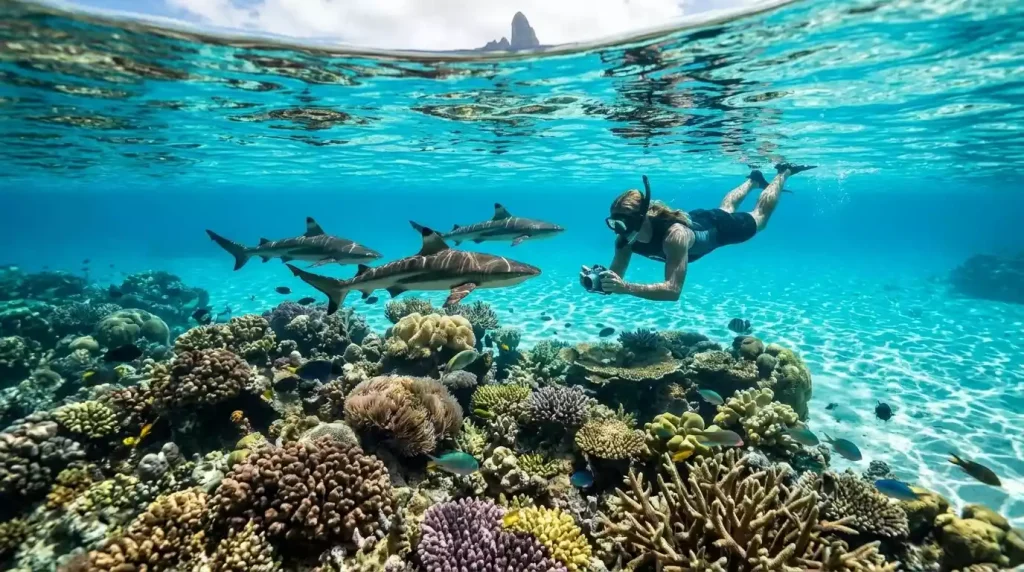
Bora Bora’s lagoon is not the Maldives. The reef health here, while genuinely good in the areas immediately around the Four Seasons property, has experienced the pressures that come with decades of intensive luxury tourism development. Visibility is excellent. Marine life is present and active. But if you are a serious diver or snorkeler accustomed to the caliber of reef available in a UNESCO Biosphere Reserve like the Baa Atoll in the Maldives, you will notice the difference.
That said, the snorkeling directly from the bungalow decks is genuinely rewarding. Blacktip reef sharks are a consistent presence in the shallows — they are not aggressive and most guests find the experience of swimming alongside them exhilarating rather than alarming. Lemon sharks, eagle rays, and diverse reef fish are all present around the property’s pier and overwater structures.
The resort’s excursion program extends the water experience significantly. Shark and ray feeding tours in the middle of the lagoon — where guests enter the water alongside three-meter lemon sharks and multiple sting rays in calm, shallow conditions — are consistently the most memorable activity in guest reviews. These tours operate daily and can be booked through the resort’s activities team.
Parasailing over the lagoon offers something no underwater experience can provide: altitude. Seeing the full sweep of the lagoon from above — the gradients of color from deep blue to near-white over the shallows, the coral heads visible from 200 feet up, the island and its mountain below you — reframes everything else you’ve seen at water level and gives it a context that stays with you.
What Four Seasons Bora Bora Does Not Do Well
Every honest review has this section. Here is where the Four Seasons Bora Bora experience has genuine gaps.
The cultural experience is thin. French Polynesia has a rich and distinctive culture — Polynesian language, tradition, music, and connection to the ocean that are genuinely interesting and completely accessible if you leave the resort and engage with the island. Four Seasons Bora Bora makes minimal effort to bring that culture into the resort experience in a meaningful way. The decor borrows Polynesian motifs. The menu includes a few local ingredients. The welcome lei is genuine. Beyond that, the cultural immersion available here is less than you would find at, say, Keemala in Phuket, which builds its entire identity around a fictional Polynesian tribe concept with more conviction than the real thing delivers here.
The pool situation needs managing. The main infinity pool is beautiful and positioned perfectly against the lagoon and mountain backdrop. It is also the busiest area of the resort and, on full-occupancy days, the atmosphere around it is more social than serene. Guests seeking quiet should orient their time around the bungalow deck rather than the communal pool.
French Polynesia is expensive to reach. This is not the resort’s fault, but it is part of the total calculation. Flights from most origins require a connection through Los Angeles or Auckland, and the journey time from Europe or Southeast Asia is significant. Compared to a Maldivian resort accessible from a major hub like Dubai or Singapore, the logistical overhead of getting to Bora Bora is greater, and return flights from Papeete to most long-haul origins are priced accordingly. Factor this into your overall trip budget.
The motu is small. The resort occupies most of its landmass. There is no option to take an evening walk beyond the resort boundaries, no neighboring village or local market, nowhere to go that isn’t managed Four Seasons territory. For some guests, this is exactly the appeal — total containment, no decisions to make. For others, after four or five nights, it starts to feel confining. Know which guest you are before you book a long stay.
Who Should Stay Here — and Who Should Not
Four Seasons Bora Bora is the right choice for a specific kind of traveler. Being clear about this saves time, money, and the particular disappointment of going somewhere extraordinary and finding it isn’t quite right for you.
This resort is genuinely exceptional for couples on significant trips — honeymoons, landmark anniversaries, milestone birthdays — where the experience of being somewhere undeniably beautiful, impeccably managed, and genuinely remote is the point in itself. The visual drama of the setting, the quality of the service, and the intimacy of the bungalow format all align perfectly for that purpose.
It works well for travelers who have stayed in high-end hotels before and know what to expect from the Four Seasons brand. First-time luxury travelers sometimes report a slight dissonance between the price and the experience — not because anything is wrong, but because the value of what’s being delivered is partly experiential and partly reputational, and the reputational component requires context to appreciate.
It is probably not the right choice for guests whose primary motivation is diving or serious snorkeling. The Maldives — particularly properties in the Baa Atoll — offer materially better reef experiences at comparable price points. It is not ideal for travelers who want genuine cultural immersion alongside their luxury, or for those who are sensitive to the feeling of being on a small managed island with limited external access.
And it is not a budget-friendly version of itself. There is no “good deal” tier at Four Seasons Bora Bora. The entry-level experience is expensive, the extras add up, and the French Polynesia transport premium is fixed. If you are stretching financially to make this trip happen, that stretch will be present in your experience. The travelers who get the most from this resort are those who are paying comfortably, not those who are paying sacrificially.
The Honest Cost Breakdown for 2026
This is the section most review sites avoid. Here is what a realistic Four Seasons Bora Bora trip actually costs in 2026:
- Overwater bungalow: From approx. $2,500/night. A four-night stay in a standard overwater bungalow starts around $10,000 before anything else.
- Seaplane or boat transfer from Bora Bora airport: Included for Four Seasons guests — one of the few costs the resort absorbs.
- International flights: Expect $1,500–$3,500+ per person depending on origin and booking timing. Flights from Europe or Australia are at the higher end.
- Meals and drinks: Budget $250–$400 per couple per day at the resort. A four-night stay adds approximately $1,000–$1,600 to the room cost.
- Excursions: Shark and ray tour approx. $150–$200 per person. Parasailing approx. $100–$130 per person. Day trips to Bora Bora town priced separately.
- Realistic total for two people, four nights: $15,000–$20,000+ including flights, accommodation, meals, and activities.
Written out like that, it is a lot of money. It is also, for the right traveler at the right moment, an experience with a half-life measured in decades rather than days.
Whether those two things balance is a question only you can answer.
Final Verdict
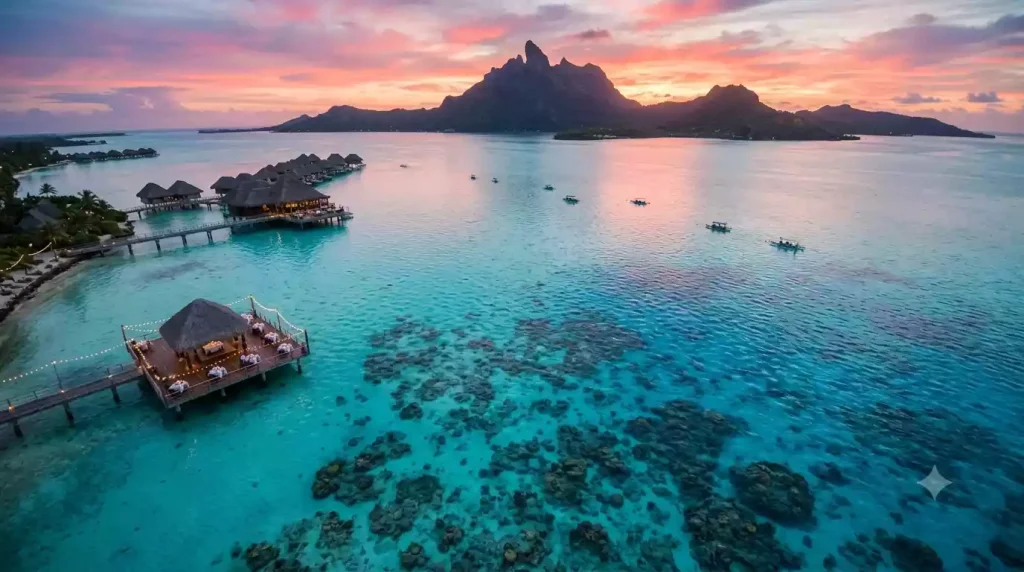
Four Seasons Resort Bora Bora is not the world’s best overwater hotel. That title — by most serious measures — belongs somewhere in the Maldives, where the reef is better, the isolation more complete, and the overwater infrastructure more refined. If you are optimizing purely for the overwater experience, the Maldives wins.
But Four Seasons Bora Bora is the world’s best vers