

Let me be upfront with you: the first time I researched overwater bungalows seriously, I almost closed the tab in disbelief. The prices felt absurd. The pictures looked photoshopped. And I convinced myself it was the kind of thing other people did — people with different budgets, different lives.
Then I kept reading. And reading. And somewhere between the third resort deep-dive and the fourth set of guest reviews, something shifted. Because the more you learn about what the best overwater bungalows actually offer, the less they feel like an indulgence and the more they start to feel like the most honest version of a trip you will remember forever.
This guide is the result of extensive research across every major overwater destination in the world — the Maldives, Bora Bora, Fiji, and beyond. I’ve dug into real guest experiences, resort documentation, marine environment data, and the kind of fine-print details that travel brochures never mention. What follows is the most honest, practical breakdown of the best overwater bungalows you can book right now.
No filler. No generic descriptions recycled from resort websites. Just what you actually need to know.
What Actually Makes an Overwater Bungalow Worth the Price?
This is the question most guides skip over — and it’s the most important one.
Not all overwater bungalows deliver the same experience. Some are genuinely transformative. Others are overpriced rooms on stilts with murky water and disappointing reefs. The difference comes down to a handful of variables that most travelers don’t think to research until it’s too late.
The reef beneath the villa matters more than almost anything else. An overwater bungalow above degraded or shallow coral is just a room with a wet ladder. The best properties sit above living reef systems teeming with fish, rays, and visibility that makes stepping off your deck feel like entering a nature documentary.
Spacing and orientation determine whether you feel secluded or exposed. Some resorts pack overwater villas so closely together that you can hear your neighbors having breakfast. The properties on this list were chosen, in part, because their layout actually delivers the privacy the brochures promise.
Direct water access is non-negotiable. A ladder or staircase from your deck into the lagoon isn’t a bonus — it’s the whole point. If you have to walk to a shared entry point, you’ve lost something fundamental.
Service at scale makes or breaks it. When you’re paying this kind of money to be this far from anywhere, the gap between good service and exceptional service is felt acutely. Resorts with a genuine butler or personal host system consistently outperform those without.
With that framework in mind — here are the eight overwater bungalow properties that genuinely earn their reputation.
1. Gili Lankanfushi — North Malé Atoll, Maldives
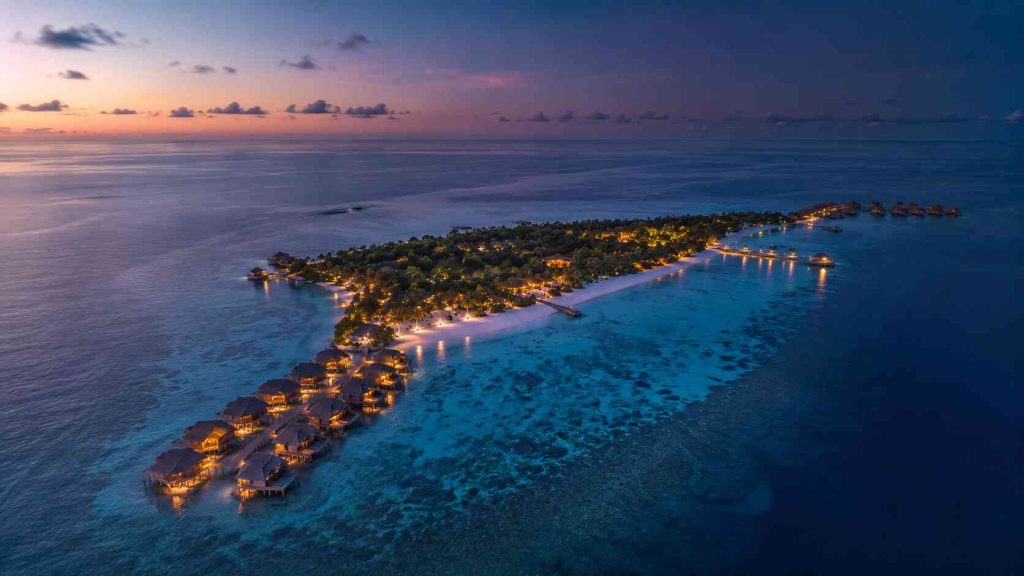
The one that keeps winning. There’s a reason.
There is a question that comes up every year in serious travel circles: what is the single best overwater villa in the world? And year after year, Gili Lankanfushi’s Private Reserve enters the conversation — not because it’s the flashiest, but because it gets the fundamentals so completely right.
The resort is built almost entirely from natural wood, bamboo, and sustainably sourced thatch. There are no roads. No cars. No concrete pathways that remind you a hotel developer was once making decisions here. Guests move around by bicycle or by boat, which sounds like a minor detail but completely resets how you experience time from the moment you arrive.
The overwater villas sit above one of the most pristine house reefs in North Malé Atoll. Glass floor panels built into the living areas give you a private window into the reef at all times — reef sharks glide past in the early morning, and the fish activity beneath the deck is constant enough that some guests report spending entire afternoons just watching from the floor. Each villa comes with a “Mr. Friday” — the resort’s name for a personal butler who functions less like a service role and more like a thoughtful companion for your stay, anticipating preferences you haven’t yet voiced.
What makes Gili Lankanfushi stand apart from flashier alternatives is the quiet, considered nature of the whole experience. This is not a resort that tries to impress you with scale. It impresses you by making you feel that the ocean — this particular piece of it — was somehow arranged for you.
- Best for: Couples, sustainability-conscious travelers, anyone who wants the Maldives distilled to its most essential form
- Price: From approx. $2,000/night
- The detail worth knowing: The “Mr. Friday” system is genuinely different from standard butler service — staff are assigned before arrival and research guest preferences in advance
2. Soneva Jani — Noonu Atoll, Maldives
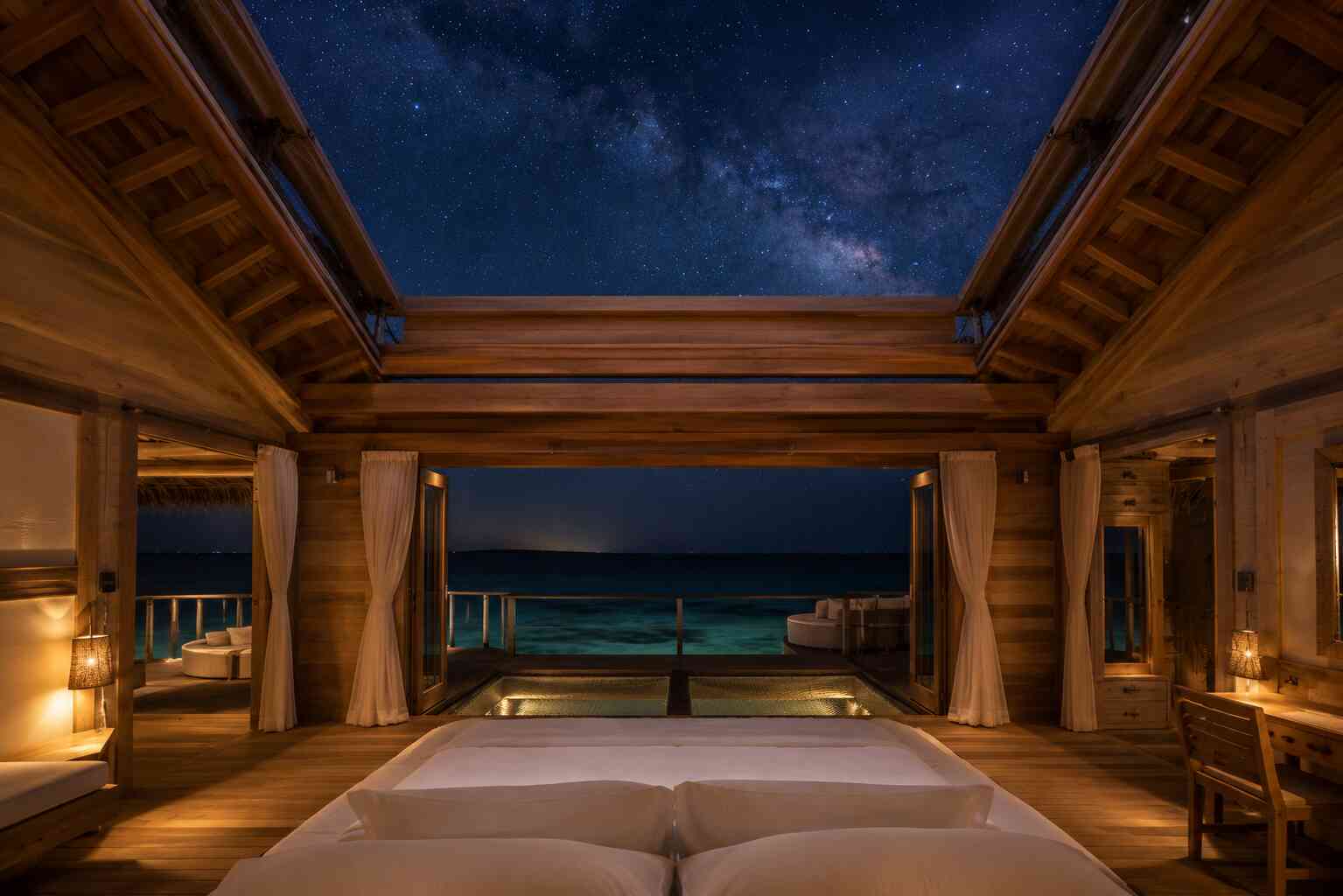
If you ever thought “I want the most dramatic overwater villa that exists” — this is your answer.
Soneva Jani operates at a scale that is, honestly, slightly hard to process when you first encounter it. The Water Retreats here are some of the largest overwater accommodations ever constructed — the biggest units span multiple levels and exceed 13,000 square feet. That is not a typo.
But the feature that gets talked about the most is neither the size nor the private pool on every deck. It is the retractable roof above the bedroom. At night, with the push of a button, the ceiling opens to reveal the Maldivian sky — a sky that, in the remote Noonu Atoll, 45 minutes by seaplane from Malé, is darker and more star-filled than most travelers will ever have seen before. Guests describe lying in bed watching the Milky Way move overhead as something close to a religious experience, which sounds like hyperbole until you’ve looked at the photographs.
There is also a waterslide off the villa deck directly into the lagoon, which captures something important about Soneva Jani’s personality: this is a resort that takes extraordinary luxury seriously but has never forgotten how to be genuinely fun.
You May Also Like



Soneva is also one of the most credible sustainability operators in the Maldives, with documented investment in solar infrastructure, waste elimination, and active coral restoration programs that guests can participate in.
- Best for: Families, couples who want maximum space, anyone for whom “best” means “biggest and most dramatic”
- Price: From approx. $4,000/night
- The detail worth knowing: Book during a new moon for the clearest possible sky through the open roof
3. Four Seasons Resort Bora Bora — French Polynesia
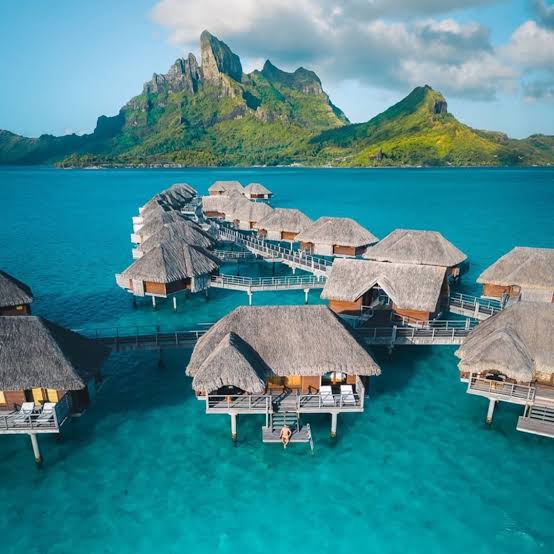
The birthplace of the overwater bungalow, executed at its highest level.
The overwater bungalow was invented in French Polynesia in the 1960s, and Bora Bora remains the destination most synonymous with the concept worldwide. If you want the original experience — the volcanic island backdrop, the impossibly turquoise lagoon, the view that has appeared in more honeymoon photographs than any other on earth — then Bora Bora is where you go. And if you’re going to Bora Bora, Four Seasons is the property that most consistently delivers on the island’s considerable promise.
Mount Otemanu is the anchor of everything here. The extinct volcano rises 727 meters above the lagoon and is visible from almost every point in the resort — from the deck of your bungalow in the morning, from the infinity pool at sunset, from the water as you snorkel the lagoon at midday. The mountain changes color throughout the day in ways that are genuinely arresting, and its presence gives the Bora Bora overwater experience something the Maldives simply cannot offer: a dramatic, ancient landscape to set against the water.
Each overwater bungalow features a private plunge pool, a glass floor panel, and a staircase leading directly into the lagoon. The lagoon here is rich with marine life, and the resort’s snorkeling is exceptional by French Polynesian standards. The spa, set partially over the water, offers treatments informed by traditional Polynesian techniques that feel genuinely connected to the culture rather than decorative.
The honest comparison to the Maldives: Bora Bora offers more visual drama. The Maldives offers better reef and more seclusion. Which matters more depends on you.
- Best for: First-time overwater travelers, honeymooners, anyone drawn specifically to that iconic volcanic backdrop
- Price: From approx. $2,500/night
- The detail worth knowing: Sunrise from the east-facing decks, with Mount Otemanu catching the first light, is reliably one of the most photographed moments in guest reviews
4. St. Regis Bora Bora Resort — French Polynesia
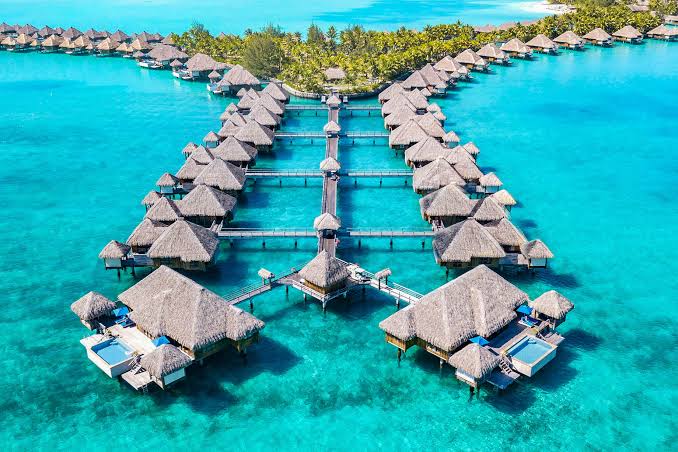
For guests who believe that service is the actual luxury.
There is a version of the Bora Bora experience where the setting is secondary to the experience of being looked after with exceptional precision — and that is exactly what the St. Regis delivers. The resort’s Otemanu Overwater Villa, a two-bedroom suite with unobstructed lagoon and mountain views, is among the most exceptional accommodations in the entire Pacific.
What separates St. Regis Bora Bora from its neighbors is the consistency and culture of its service program. The Butler service here isn’t a title attached to an assistant — it is a philosophy that runs through every department, producing a stay where the gap between what you want and what arrives seems to close before you’ve finished forming the thought. The timing of champagne as the sun drops. The rearrangement of deck furniture before you’ve realized you wanted it moved. Small things, done consistently, that add up to something remarkable.
The lagoon snorkeling directly from the overwater villas is among the best in Bora Bora, and the dive center operates some of the most knowledgeable guided reef experiences available on the island.
- Best for: Guests who prioritize service above all else, couples on significant anniversaries
- Price: From approx. $1,800/night
- The detail worth knowing: The resort’s butler team is known for building genuine relationships over multi-night stays — longer visits are disproportionately rewarded
5. Waldorf Astoria Maldives Ithaafushi — South Malé Atoll, Maldives
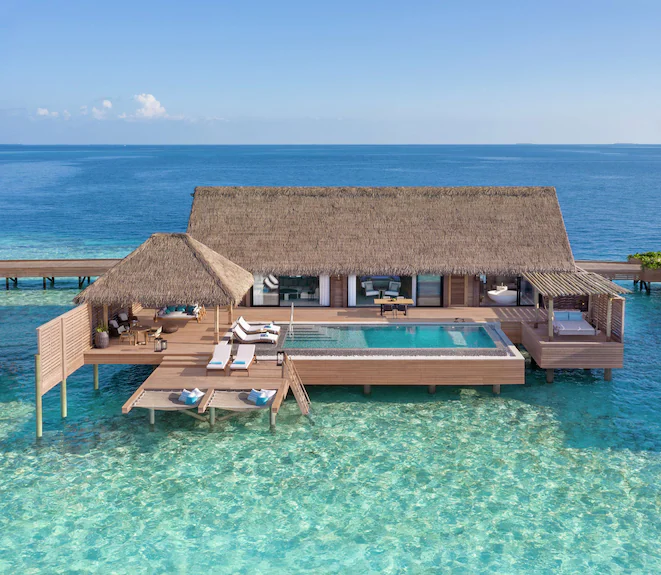
Architecture as an argument. This resort makes a strong one.
When the Waldorf Astoria Maldives opened, it announced itself through design rather than noise. The overwater villas here are among the most architecturally considered in the archipelago — which is a significant claim in a country that has been building overwater accommodations for decades and has refined the form considerably.
The Grand Overwater Villas are built on three private islands, and each draws on modern Maldivian design references to produce a visual language that feels genuinely rooted in its context rather than imported from a global luxury template. Private infinity pools, outdoor bathtubs positioned over the water, and glass floors in the living areas complete a picture that is genuinely beautiful in a way that is harder to achieve than most resorts acknowledge.
What’s less talked about but equally impressive is the dining program. The resort operates multiple restaurants across Japanese, Italian, Indian, and contemporary Maldivian cuisine — a breadth that is genuinely rare at overwater properties, most of which offer limited options by necessity. On a long stay, this matters considerably.
- Best for: Design-conscious travelers, guests who want to eat exceptionally well while they’re there
- Price: From approx. $2,200/night
- The detail worth knowing: The three-island layout means the resort has a sense of scale and variety that single-island properties can’t match
6. Likuliku Lagoon Resort — Malolo Island, Fiji
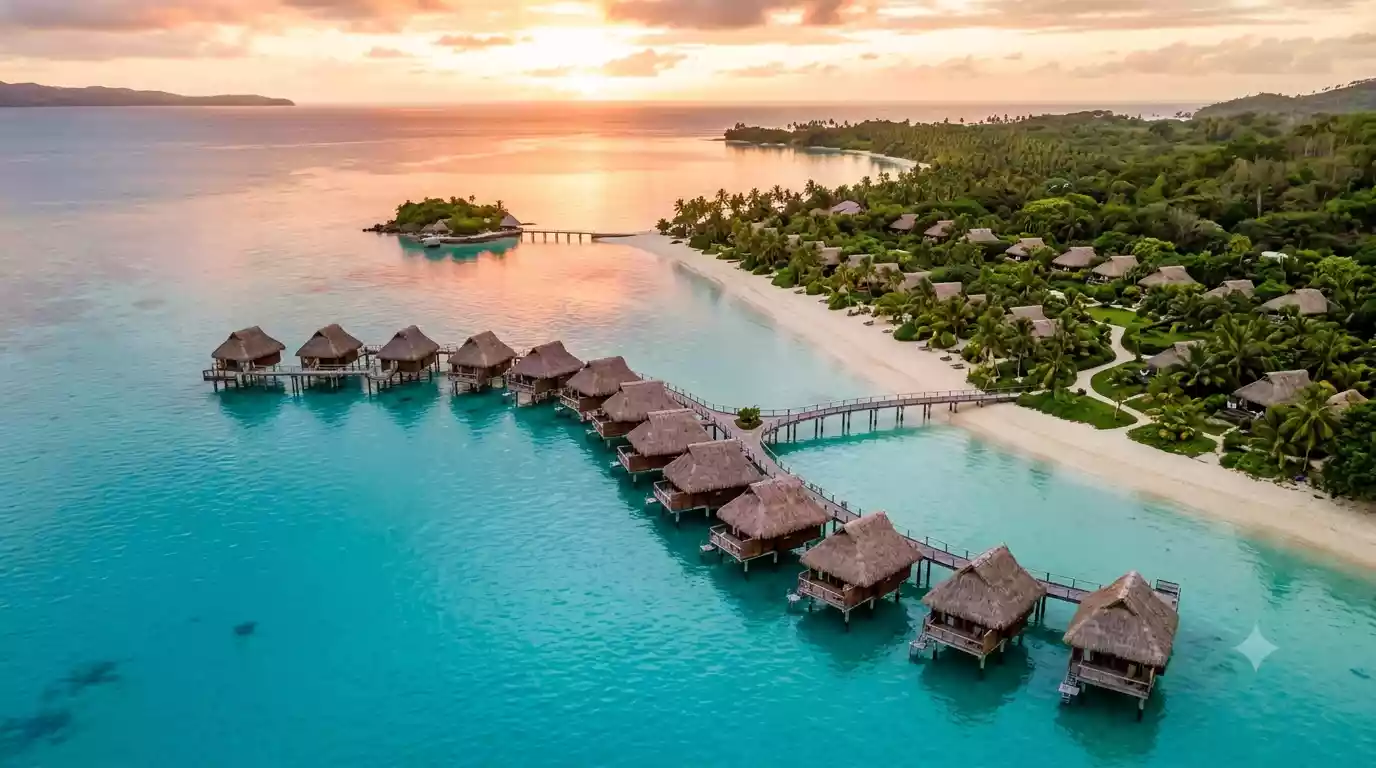
The Maldives alternative that deserves far more attention than it gets.
Here is something that most overwater bungalow guides won’t tell you: if you have never stayed in an overwater property before, Likuliku Lagoon Resort in Fiji might be the most honest place to start — not because it’s lesser than the Maldives, but because it offers something the Indian Ocean cannot.
Likuliku is the only resort in Fiji with genuine overwater bures — bure being the traditional Fijian word for a dwelling, and the distinction matters here because it is not just a naming convention. The cultural texture of a Fijian overwater stay is genuinely different from a Maldivian or Polynesian one. The warmth of the staff carries a quality that regular guests describe as unique — less formal than the Maldives, more genuine than the performance of hospitality that very expensive resorts can sometimes produce.
The lagoon at Malolo Island is exceptionally clear, and the coral beneath the bures is in good health, making snorkeling directly from the deck a real pleasure rather than a disappointment. The value relative to comparable Maldivian properties is also notable — you are getting a world-class experience at a price point that, in 2026, is genuinely more accessible.
If you are building a trip through the South Pacific, this is the overwater experience that rewards you without requiring the Indian Ocean price tag.
- Best for: First-time overwater guests, travelers combining South Pacific destinations, anyone who wants world-class quality without Maldivian prices
- Price: From approx. $1,100/night
- The detail worth knowing: Likuliku’s remoteness from Nadi Airport (about 20 minutes by seaplane or 1.5 hours by boat) is part of what keeps it uncrowded
7. Anantara Kihavah Maldives Villas — Baa Atoll, Maldives
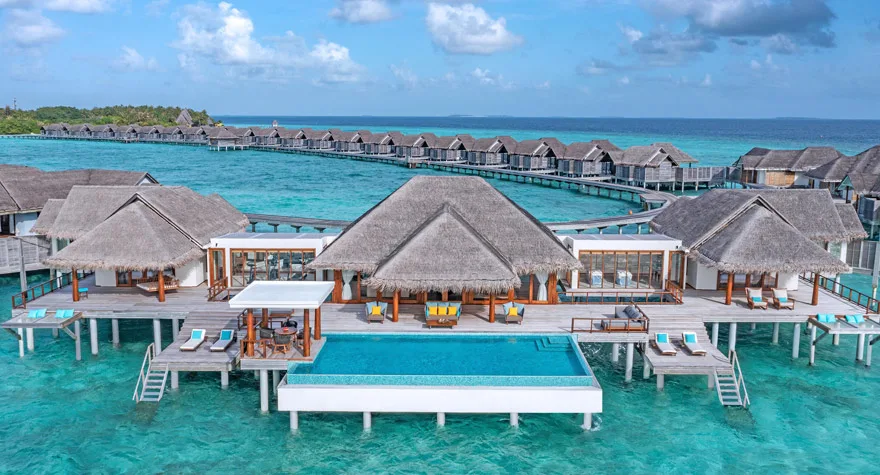
The right choice if what you really want is to see manta rays from your bedroom.
The Baa Atoll is a UNESCO Biosphere Reserve. That designation matters more than most UNESCO labels because in this case it reflects something you can actually experience directly: the marine biodiversity here is exceptional even by Maldivian standards, and the presence of manta rays — which aggregate in the Baa Atoll in significant numbers during certain months — is the signature wildlife experience that draws repeat visitors back year after year.
At Anantara Kihavah, the overwater villas sit above a house reef that is consistently described by marine biologists and serious divers as among the most vibrant in the archipelago. Glass floors throughout the villas give constant visual access to this reef, and the private sun decks lead by staircase into water where reef activity is essentially guaranteed at any hour.
The resort’s underwater restaurant and underwater spa deserve special mention — not as gimmicks, but as genuinely excellent experiences that extend your relationship with the ocean throughout the day rather than limiting it to the villa deck. If you’ve read our guide to the most beautiful underwater hotels in the world, you’ll understand exactly what it means to dine beneath the surface of a living reef.
- Best for: Marine life enthusiasts, divers, anyone who wants the water to be the central experience of the stay
- Price: From approx. $1,900/night
- The detail worth knowing: Plan around the manta ray season (May–November for the Baa Atoll) to maximize the chance of extraordinary sightings from both your deck and guided dives
8. Conrad Maldives Rangali Island — South Ari Atoll, Maldives
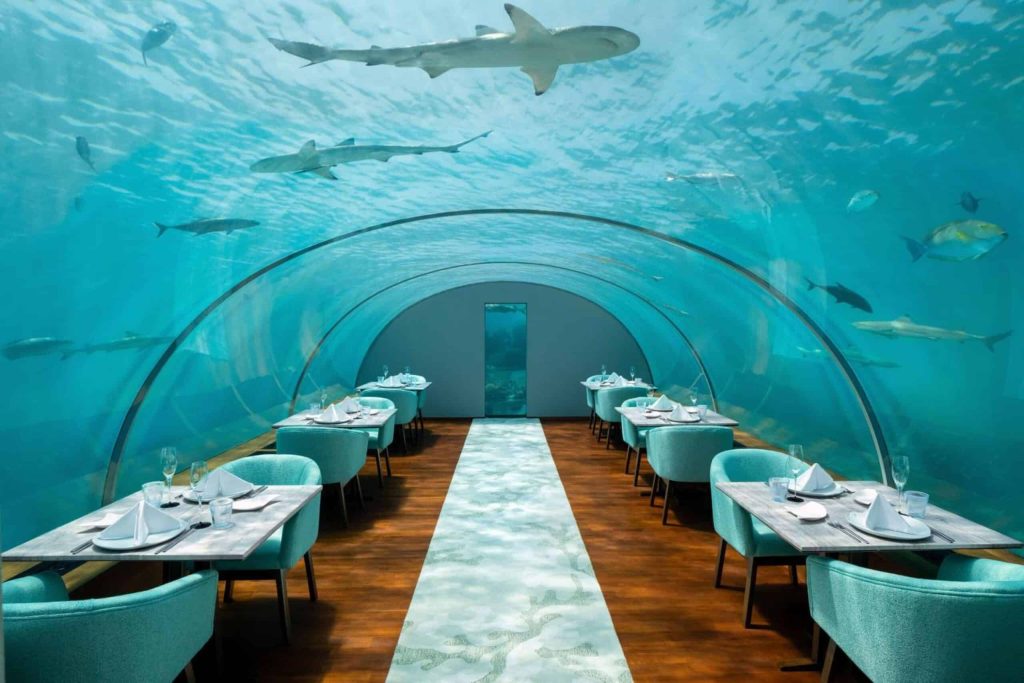
The legendary name that still earns its reputation.
Conrad Maldives Rangali Island has been famous for longer than most of its competitors have existed. It is the home of the original underwater restaurant — a concept that felt like science fiction when it opened and has inspired a generation of underwater dining experiences worldwide. If you’ve seen our breakdown of the most beautiful underwater hotels in the world, you’ll already know what Conrad Rangali contributed to that conversation.
But the overwater villas here stand independently of the resort’s famous innovations. The Water Villas sit above some of the best-maintained coral in South Ari Atoll, and the snorkeling directly from the deck is consistently exceptional. The dual-island layout — two islands connected by a 500-meter footbridge over the lagoon — gives the resort an unusual sense of variety and scale, with different moods and settings available within a single property.
What particularly distinguishes Conrad Rangali for families is the quality of its children’s programming, which is among the most thoughtfully designed in the Maldives. For parents who want the overwater experience without the pressure of keeping young children occupied in an environment designed exclusively for couples, this is a rare property that genuinely delivers for everyone.
If you want a detailed look at this extraordinary property, read our full Conrad Maldives Muraka Review
- Best for: Families, guests who want an established iconic property with a track record
- Price: From approx. $1,600/night
- The detail worth knowing: The Muraka underwater villa — a dedicated two-level residence with a submerged bedroom — is available at Conrad Rangali for guests wanting to combine overwater and underwater experiences in a single stay
Maldives vs. Bora Bora vs. Fiji: The Honest Comparison
This question comes up in every overwater bungalow conversation, and the honest answer is that they suit different travelers.
Choose the Maldives if the reef, the water quality, and the marine biodiversity are your priority. The Indian Ocean offers the most consistently pristine lagoons, the most developed overwater infrastructure, and the widest range of options at every price point. The flat, low-lying atolls also mean uninterrupted horizon views from every villa. The trade-off: it requires the most travel, the transfer costs add up, and it can feel performatively isolated.
Choose Bora Bora if you want a landscape — a real, dramatic landscape — to set against your lagoon. Mount Otemanu changes the nature of the experience in ways that matter. The French Polynesian cultural context is also richer and more accessible from the resort than the Maldivian equivalent. The trade-off: the French Polynesia price premium is significant, and the reef quality, while good, does not consistently match the best Maldivian properties.
Choose Fiji if you value authenticity, cultural warmth, and value without sacrificing quality. Likuliku Lagoon is a world-class property at a price that opens the overwater experience to a wider range of travelers. The trade-off: fewer overwater options overall, and the remoteness that makes it special also means the journey is substantial.
5 Practical Things to Know Before You Book
1. Budget for the full trip cost, not just the room rate.
Seaplane transfers to remote Maldivian atolls can run $500–$700 per person round-trip. Overwater properties in the Maldives and French Polynesia often charge significantly for food and beverage, and all-inclusive packages are frequently the better value on longer stays. The nightly rate is the starting point, not the final number.
2. The best rooms book 6–12 months in advance.
Peak season inventory at the top properties disappears faster than most travelers expect. If you have specific dates — especially around a milestone or peak season period — treat booking as the first task, not the last.
3. Arrive in daylight.
Seaplane transfers operate only during daylight hours, and arriving in darkness means missing the transfer entirely and waiting for the following day. Schedule flights into Malé or Papeete to arrive with time to spare.
4. Research the house reef at your specific property.
Reef health varies dramatically even within the same destination. The properties on this list have been chosen partly because their house reef quality is documented and consistently strong. If you’re considering a property not on this list, look for recent diver and snorkeler reviews specifically referencing reef health.
5. Longer stays reward you disproportionately.
The best overwater experiences take time to settle into. The second and third mornings on an overwater deck feel qualitatively different from the first. If your budget allows for even one additional night, the return is genuine.
Final Thought
There’s a specific version of this trip I want you to avoid: the one where you spend a year researching overwater bungalows, commit to a three-night stay that costs more than you’ve spent on any previous holiday, and then spend the whole time taking photographs of it rather than being inside it.
The overwater bungalow experience at its best is almost aggressively simple. Wake up. Look at the water. Walk into it. Repeat. The properties on this list are here because they have constructed environments where that simplicity is genuinely available — where the infrastructure is good enough, the reef healthy enough, and the service considered enough that there’s nothing left to manage except being present.
That’s harder to manufacture than it sounds. These eight properties do it consistently. That’s why they’re on this list.
Explore more luxury hotel guides on Plishere: