
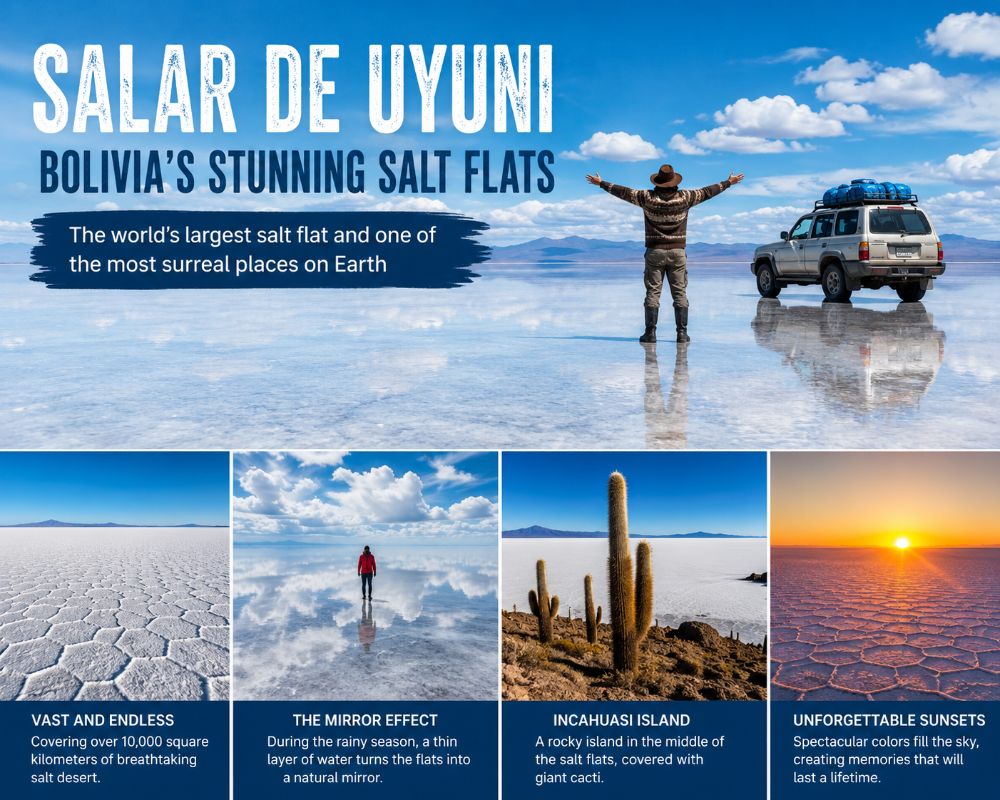
Few places on Earth feel as surreal as Salar de Uyuni. Located in southwestern Bolivia, this extraordinary natural wonder attracts travelers from around the world with its endless white landscape, breathtaking reflections, and unique geological history. Covering more than 10,000 square kilometers, Salar de Uyuni is the largest salt flat on the planet and one of South America’s most unforgettable destinations.
Whether you are an adventure seeker, a photographer, or simply someone who loves exploring unique places, a visit to Salar de Uyuni promises an experience unlike any other. From its mirror-like surface during the rainy season to its vast salt desert during the dry months, this remarkable destination continues to captivate visitors year after year.
Where Is Salar de Uyuni?
Salar de Uyuni is located in the Potosí Department of Bolivia, high in the Andes Mountains. Sitting at an elevation of approximately 3,650 meters above sea level, the salt flat stretches across a massive area of the Altiplano, one of the highest plateaus in the world.
The nearest town is Uyuni, which serves as the main gateway for travelers exploring the region. Most visitors begin their journey here before joining guided tours that take them across the spectacular white landscape.
The remote location adds to the sense of adventure. As you travel toward the salt flats, the scenery gradually transforms into a vast and seemingly endless white horizon that feels more like another planet than a destination on Earth.
The Fascinating History Behind the Salt Flats
Thousands of years ago, the region was covered by enormous prehistoric lakes. Over time, these lakes gradually evaporated, leaving behind thick layers of salt and minerals.
Today, Salar de Uyuni is covered by a solid crust of salt that can reach several meters in thickness. Beneath the surface lies a mineral-rich brine containing significant reserves of lithium, an essential component used in batteries for smartphones, laptops, and electric vehicles.
The unique geological history of the area has helped create one of the most unusual landscapes in the world. Scientists, photographers, and travelers continue to study and admire the salt flats because of their remarkable formation and near-perfect flatness.
Why Salar de Uyuni Is So Famous
One of the main reasons Salar de Uyuni has become a bucket-list destination is its incredible visual appearance.
During the rainy season, a thin layer of water covers the surface. This transforms the salt flat into a giant natural mirror that perfectly reflects the sky above. The horizon seems to disappear entirely, creating stunning optical illusions where the earth and sky merge into one.
Photographs taken during this period often look unreal. Travelers appear to be walking among clouds, floating in the sky, or standing between two worlds.
During the dry season, the landscape changes dramatically. The water disappears, revealing endless geometric patterns formed by crystallized salt. These hexagonal formations stretch across the horizon, creating a striking natural design that fascinates visitors and photographers alike.
The Best Time to Visit Salar de Uyuni
Choosing the best time to visit depends on the type of experience you want.
Rainy Season (December to April)
This is the most popular time for photography enthusiasts. The thin layer of water covering the salt flats creates the famous mirror effect that has made Salar de Uyuni world-famous.
The reflections during sunrise and sunset are particularly spectacular. Many travelers consider this one of the most beautiful natural sights on Earth.
However, some areas may become inaccessible due to flooding, and weather conditions can occasionally affect travel plans.
Dry Season (May to November)
The dry season offers easier access to more parts of the salt flat. Visitors can explore unique attractions such as Incahuasi Island, a rocky outcrop covered with giant cacti that rise dramatically from the white landscape.
The weather is generally more stable, making it an excellent choice for sightseeing, hiking, and longer tours across the region.
You May Also Like




Must See Attractions Around Salar de Uyuni
Incahuasi Island
One of the most iconic locations within the salt flats is Incahuasi Island. Despite its name, it is not surrounded by water but rather by a vast sea of white salt.
The island is home to hundreds of giant cacti, some of which are several centuries old. A short walk to the top rewards visitors with panoramic views of the endless salt desert.
Colchani Village
This small village is known for its traditional salt-processing activities. Visitors can learn how local communities harvest and refine salt while browsing handmade souvenirs crafted from the region’s natural resources.
Train Cemetery
Located near Uyuni, the Train Cemetery features abandoned locomotives and railway equipment dating back to Bolivia’s mining boom. The rusting trains create a fascinating contrast against the surrounding desert landscape and have become a favorite spot for photographers.
Photography Opportunities Like No Other
Salar de Uyuni is considered one of the best photography destinations in the world.
Because the landscape is so flat and lacks visual reference points, visitors can create incredible perspective illusions. People often pose with toy dinosaurs, oversized objects, or creative setups that appear impossible in photographs.
Professional photographers especially appreciate the region’s unique lighting conditions, clear skies, and dramatic reflections.
Whether you use a smartphone or a professional camera, capturing memorable images here is almost effortless.
Wildlife and Natural Beauty
While the salt flats themselves appear barren at first glance, the surrounding region supports a surprising variety of wildlife.
Travelers may encounter flamingos in nearby lagoons, along with llamas, vicuñas, and other animals adapted to the harsh high-altitude environment.
The contrast between colorful lakes, snow-capped volcanoes, and the brilliant white salt flats creates some of the most diverse scenery found anywhere in South America.
Travel Tips for Visiting Salar de Uyuni
To make the most of your trip, keep these tips in mind:
- Bring sunscreen, sunglasses, and a hat because sunlight reflects intensely from the salt surface.
- Stay hydrated to help adjust to the high altitude.
- Dress in layers, as temperatures can vary significantly throughout the day.
- Carry extra batteries and power banks, since the cold weather can drain electronic devices quickly.
- Book a reputable tour operator to ensure safety and maximize your experience.
Preparing properly will help you enjoy the journey comfortably while exploring one of the world’s most unique landscapes.
Why Salar de Uyuni Should Be on Your Travel Bucket List
Few destinations offer the combination of natural beauty, geological significance, and unforgettable experiences found at Salar de Uyuni. Whether you’re standing on an endless white desert, photographing the famous mirror reflections, or watching the sun set over the Andes Mountains, every moment feels extraordinary.
Its vast scale, unique history, and dreamlike scenery make it one of the most remarkable places on Earth. For travelers seeking something beyond traditional tourist destinations, Salar de Uyuni delivers an adventure that remains memorable long after the journey ends.
If you’re planning a future trip to South America, make sure Bolivia’s incredible salt flats are at the top of your travel bucket list. Once you witness the magic of Salar de Uyuni for yourself, you’ll understand why it continues to inspire travelers from every corner of the world.