
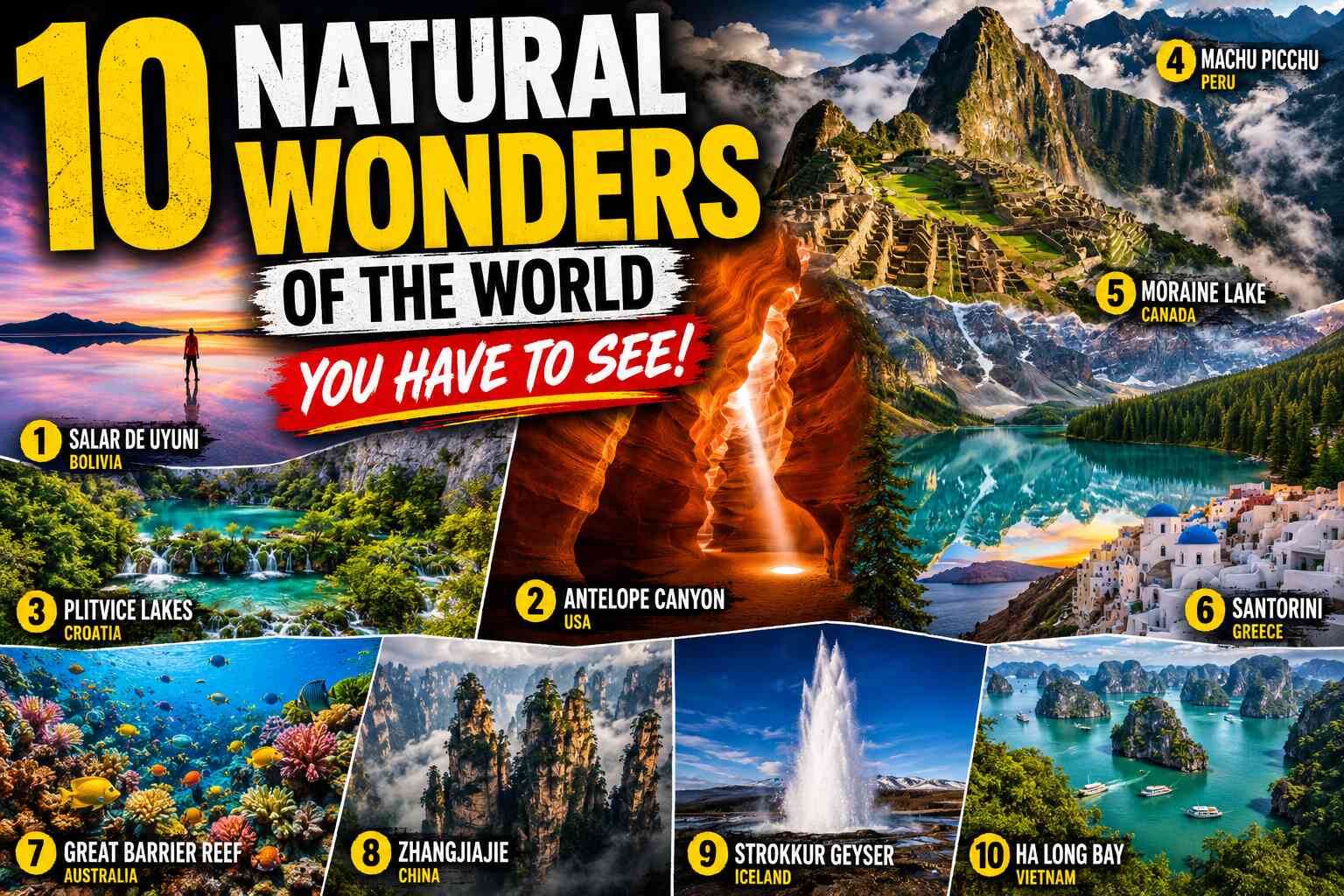
There’s a particular kind of silence you find at the edge of a great natural wonder. Standing at the rim of Antelope Canyon as a shaft of light cuts through the stone. Watching mist rise from the terraced lakes at Plitvice at dawn. Looking out across 10,000 square kilometers of Bolivian salt flat that has turned into a perfect mirror overnight. These places don’t need filters, captions, or context. They speak entirely for themselves.
This guide covers ten of the most breathtaking natural wonders of the world — destinations that belong on every serious traveler’s bucket list. For each one, we go beyond the basics: what makes it genuinely special, when to go, what to actually do there, and what kind of traveler it suits best.
1. Salar de Uyuni, Bolivia — The World’s Largest Natural Mirror
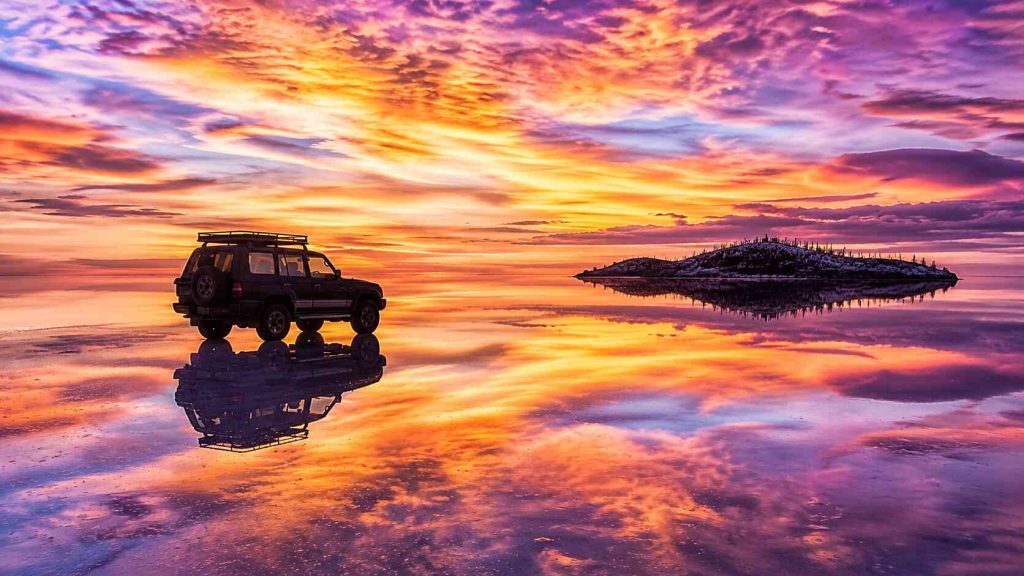
Salar de Uyuni defies easy description because nothing in everyday life prepares you for it. The world’s largest salt flat covers more than 10,582 square kilometers of the Bolivian Altiplano at an altitude of 3,656 meters — an ancient prehistoric lake that evaporated and left behind a vast, impossibly flat crust of salt up to ten meters thick in places. In the dry season, the geometric hexagonal salt patterns stretch to every horizon. In the rainy season, a thin layer of water transforms the entire surface into the world’s largest natural mirror, reflecting the sky so perfectly that the horizon disappears entirely.
The surrounding landscape amplifies the surreal quality of the experience. Isla Incahuasi — a cactus-covered island rising from the middle of the flats — offers elevated views over the white expanse. The Eduardo Avaroa Andean Fauna National Reserve on the southern edge brings colored lagoons tinted red and green by algae, pink flamingos feeding in the shallows, and steaming geysers at 5,000 meters altitude. Stargazing on the salt flats at night, with zero light pollution and the altitude bringing the Milky Way remarkably close, is one of the most extraordinary experiences in travel.
Best time to visit: December–April for the mirror effect; May–November for the geometric salt patterns and clearer skies.
Best for: Photographers, adventure travelers, bucket list seekers.
Getting there: Fly into Uyuni (UYU) or overland from La Paz or Potosí. Most visitors join a 3-day salt flat tour departing from Uyuni town.
👉 Full guide: Salar de Uyuni Bolivia Salt Flats Guide
2. Antelope Canyon, Arizona, USA — Where Light Becomes Art
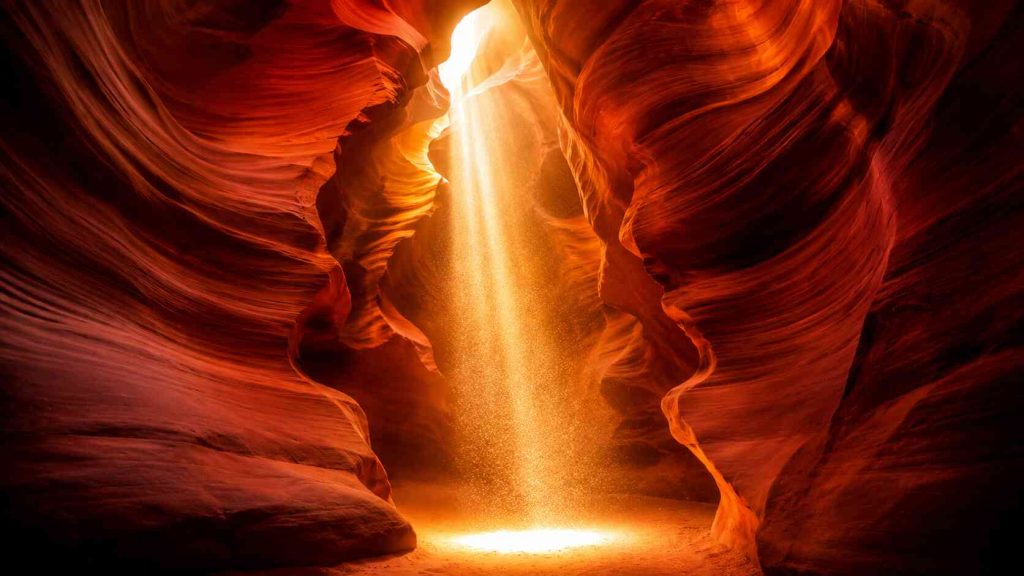
Antelope Canyon is the most photographed slot canyon in the American Southwest — and possibly the most photographed natural formation in the world. Located on Navajo land near Page, Arizona, it was carved over centuries by flash flooding and wind erosion into a series of flowing, wave-like sandstone passages that glow in extraordinary shades of orange, red, and gold. The walls curve and undulate like frozen silk, and the light that filters down through the narrow opening above creates the famous “light beam” effect that photographers travel from around the globe to capture.
There are two sections: Upper Antelope Canyon (also called “The Crack”) is the more accessible and more photographed, with its wider passages and the most dramatic light beams typically visible between 10am and 1pm from March through October. Lower Antelope Canyon (also called “The Corkscrew”) requires navigating ladders and narrow passages but tends to be less crowded and equally stunning in a more intimate way. Both sections are accessible only with licensed Navajo guides, which is a genuine advantage — local guides know exactly where and when the light performs best, and the Navajo Nation’s stewardship of the site ensures it remains protected.
Best time to visit: March–October for light beams; midday hours for the most dramatic shaft effects.
Best for: Photographers, nature lovers, Southwest road trip itineraries.
Tip: Book tours well in advance — Upper Antelope Canyon sells out weeks ahead during spring and summer.
👉 Full guide: Antelope Canyon Tour Guide — Everything You Need to Know
3. Plitvice Lakes National Park, Croatia — Europe’s Most Beautiful Waterfall System
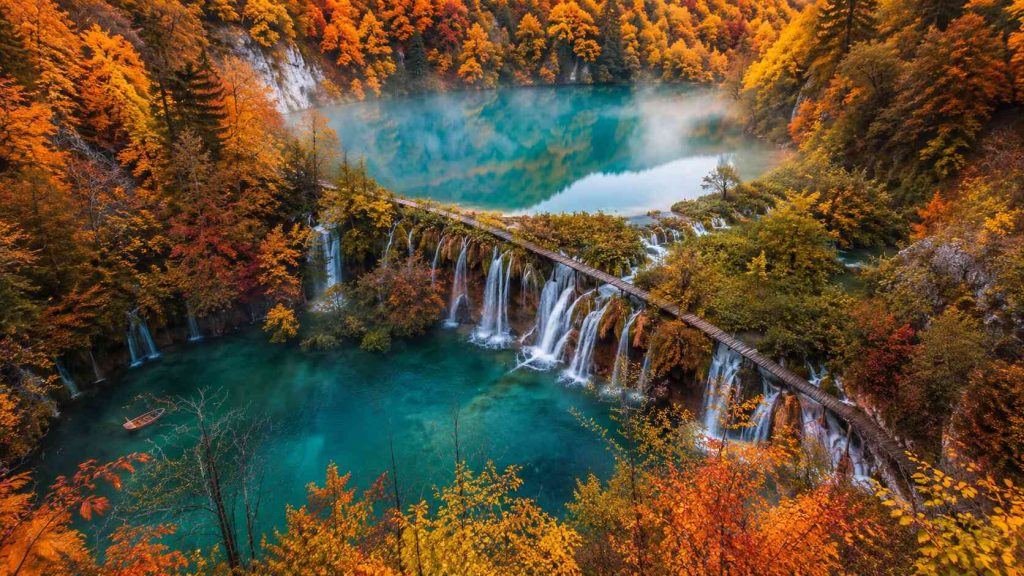
Croatia’s most visited national park is also its most extraordinary. Plitvice Lakes National Park in the heart of Lika region features a series of 16 terraced lakes connected by more than 90 waterfalls, all set within a forest of beech, spruce, and fir that shifts between brilliant green in summer and burning orange and gold in autumn. The water’s color — an ethereal turquoise and emerald that shifts with the light — comes from the calcium carbonate and magnesium in the limestone bedrock, which creates a constant slow-motion process of travertine barrier formation. The waterfalls are literally building themselves while you watch.
The park covers 296 square kilometers and is divided into Upper and Lower Lakes, connected by wooden boardwalks that wind through the forest and directly over the water. The Lower Lakes are more dramatic — the Veliki Slap waterfall at 78 meters is Croatia’s tallest — while the Upper Lakes are broader and more serene. A full circuit of both sections takes approximately 4–6 hours. UNESCO granted the park World Heritage status in 1979, and the biodiversity here — brown bears, wolves, lynx, rare bird species — is exceptional for Central Europe.
Best time to visit: April–May and September–October (shoulder season — fewer crowds, excellent color, good weather).
Best for: Nature lovers, hikers, photographers, families.
Tip: Arrive at opening time (7am) to have the boardwalks largely to yourself for the first hour.
4. Machu Picchu, Peru — The Inca Citadel Above the Clouds
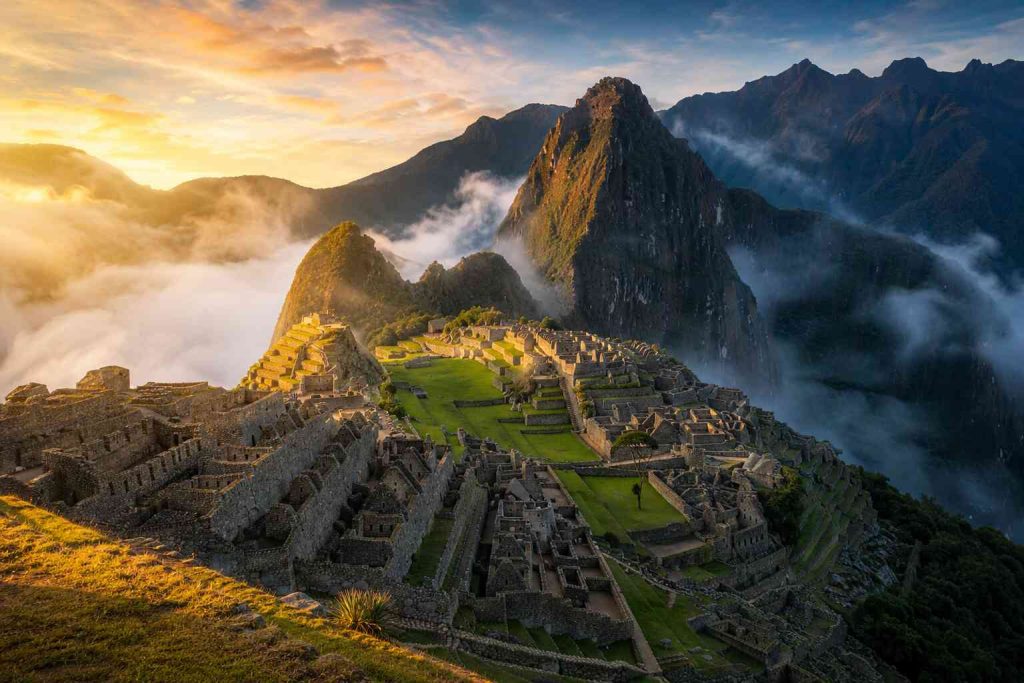
There are places in the world that exceed their reputation, and Machu Picchu is one of them. The 15th-century Inca citadel sits at 2,430 meters in the Peruvian Andes, surrounded on three sides by near-vertical mountain ridges and shrouded in morning cloud forest mist that gives the site an atmospheric quality no photograph fully captures. The engineering precision of the stonework — massive granite blocks fitted together without mortar to earthquake-resistant tolerances — becomes more impressive the longer you look at it. The Inca built this without the wheel, without iron tools, and without draft animals capable of hauling stone at altitude.
The classic approach is the four-day Inca Trail hike, which arrives at the Sun Gate above the citadel at dawn — an experience considered one of the great walks on earth. Those who prefer not to trek can take the train from Cusco to Aguas Calientes and the shuttle bus up from there, which is perfectly straightforward and delivers you to the same extraordinary place. Entry is now controlled with timed tickets and daily visitor limits, which has improved the experience significantly over the crowded conditions of previous years.
Best time to visit: May–September (dry season; best Inca Trail conditions).
Best for: History enthusiasts, hikers, photographers, solo travelers.
Tip: Book Inca Trail permits 4–6 months in advance for May–August travel. Timed entry tickets for the site also sell out — book online before your trip.
👉 Full guide: Machu Picchu Travel Guide
5. Banff National Park, Canada — The Rockies at Their Most Spectacular
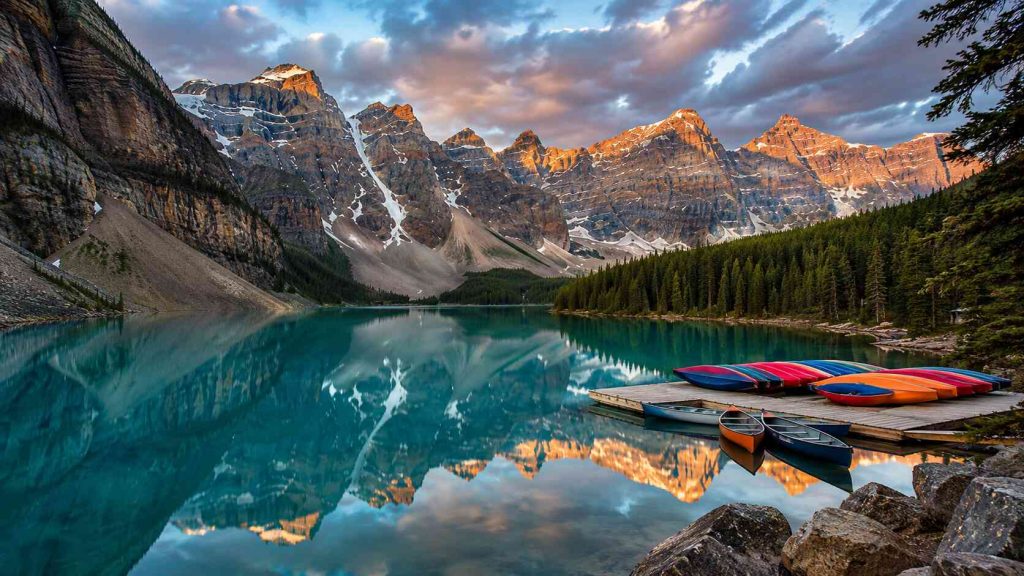
Canada’s oldest national park covers 6,641 square kilometers of the Canadian Rockies in Alberta — a landscape of glacier-fed lakes, ancient icefields, dense pine forest, and mountain peaks that consistently rank among the most photographed in North America. Moraine Lake and Lake Louise are the centrepieces: both are fed by glacial meltwater, and both have the distinctive turquoise color that comes from rock flour — fine glacial silt suspended in the water that reflects light at a specific wavelength. On a clear morning, the reflection of the Valley of the Ten Peaks in Moraine Lake is genuinely one of the most beautiful natural sights on earth.
The park rewards every season differently. Summer brings wildflower meadows, excellent hiking (the Plain of Six Glaciers trail and the Sentinel Pass scramble are highlights), and kayaking on the lakes. Autumn turns the larch trees gold from late September into October — a brief window that draws photographers from across the continent. Winter transforms Banff into a world-class ski destination, with three resorts (Sunshine Village, Lake Louise, Mount Norquay) collectively offering some of the best powder skiing in North America. The 230km Icefields Parkway drive between Banff and Jasper is one of the most scenic road trips on the planet.
Best time to visit: June–August for hiking; late September–October for larches; December–March for skiing.
Best for: Outdoor enthusiasts, families, photographers, road trippers, wildlife watchers.
Where to stay: Fairmont Banff Springs or Fairmont Chateau Lake Louise for the full Rocky Mountain grand hotel experience.
You May Also Like



6. Santorini, Greece — Volcanic Beauty Above the Aegean
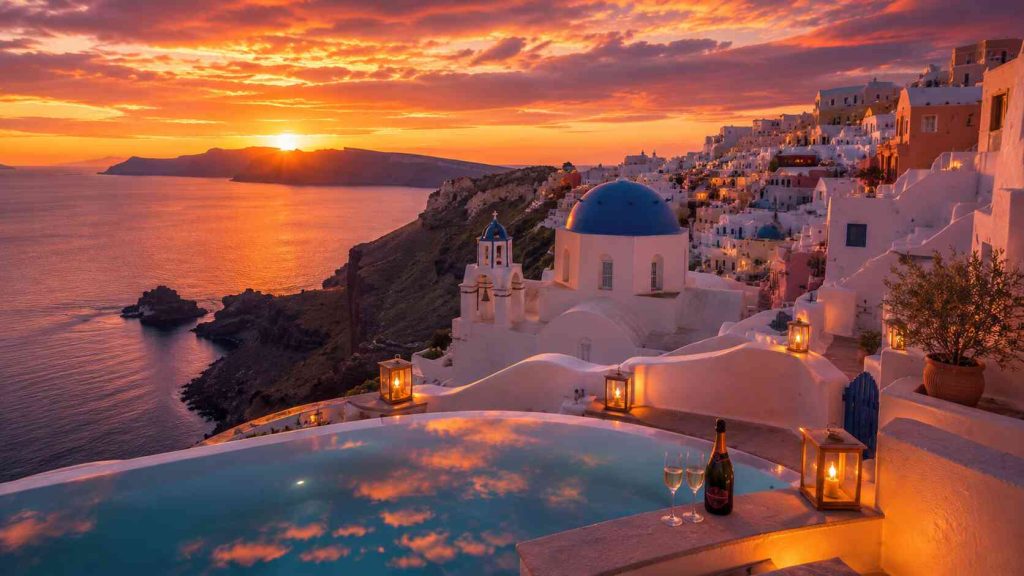
Santorini’s visual identity is so widely reproduced — the whitewashed Cycladic villages, the blue-domed churches, the caldera cliffs above the deep Aegean — that it risks feeling like a screensaver before you’ve even arrived. In person, it earns every cliché. The island is the remnant of a volcanic caldera that catastrophically collapsed around 3,600 years ago, and the dramatic crescent shape it left behind, with sheer cliffs dropping hundreds of meters to the sea, creates one of the Mediterranean’s most arresting landscapes.
Beyond the famous sunset in Oia — which does genuinely deliver, despite the crowds that gather to watch it — Santorini rewards exploration. The black-sand beach at Perissa and the red-sand beach at Akrotiri reflect the island’s volcanic geology. The ancient Minoan ruins at Akrotiri, buried by the same eruption that formed the caldera, offer one of the best-preserved Bronze Age sites in Europe. The island’s volcanic terroir produces Assyrtiko — a bone-dry white wine unique to Santorini that pairs extraordinarily well with local seafood. And the cave hotels of Oia and Imerovigli, carved directly into the caldera cliff with private plunge pools facing the sea, represent some of the Mediterranean’s finest luxury accommodation.
Best time to visit: May–June and September–October (shoulder season — warm, fewer crowds, better prices).
Best for: Honeymoons, couples, luxury travelers, photographers, wine enthusiasts.
Where to stay: Oia or Imerovigli for caldera views; Perissa or Kamari for beach access.
👉 Also see : Grace Hotel Santorini Review: A Dreamy Luxury Retreat Above the Aegean Sea
7. Great Barrier Reef, Australia — The World’s Largest Living Structure
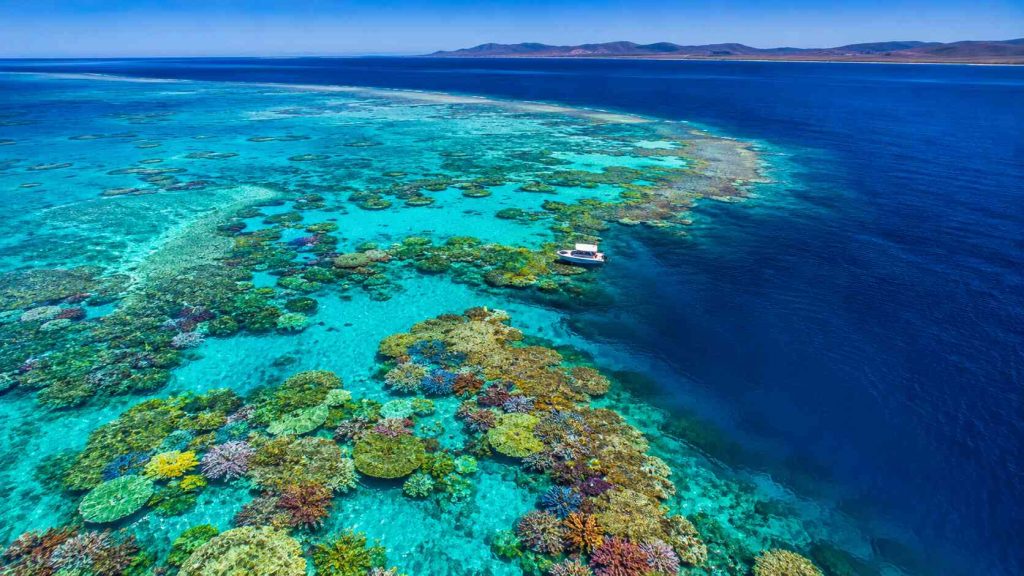
The Great Barrier Reef stretches for 2,300 kilometers along the northeast coast of Queensland — a living ecosystem of 2,900 individual reefs and 900 islands that is visible from space and is the largest structure ever built by living organisms. The scale is impossible to grasp from the water’s surface; you need to dive or snorkel into it to begin to understand what’s down there. More than 1,500 species of fish, 4,000 species of mollusk, 240 species of birds, and six of the world’s seven species of sea turtle make the reef their home.
The primary gateways are Cairns and the Whitsundays, each offering a different character. Cairns is the backpacker and dive certification hub — day boats depart the marina every morning for the outer reef, and live-aboard dive trips allow serious divers to access more remote sections inaccessible to day trippers. The Whitsundays offer a more resort-focused experience, with the iconic Whitehaven Beach (72 kilometers of pure silica sand, rated among the world’s best) and sailboat charters through the 74 islands. The reef’s conservation situation is serious — coral bleaching events driven by warming oceans have affected significant portions of the northern reef — which makes visiting a more emotionally complex experience than it once was, and a more urgent one.
Best time to visit: June–October (dry season; best visibility, cooler water, no stinger season).
Best for: Divers, snorkelers, marine life enthusiasts, families.
Tip: Choose tour operators certified by the Great Barrier Reef Marine Park Authority for responsible reef access.
8. Zhangjiajie National Forest Park, China — The Floating Mountains
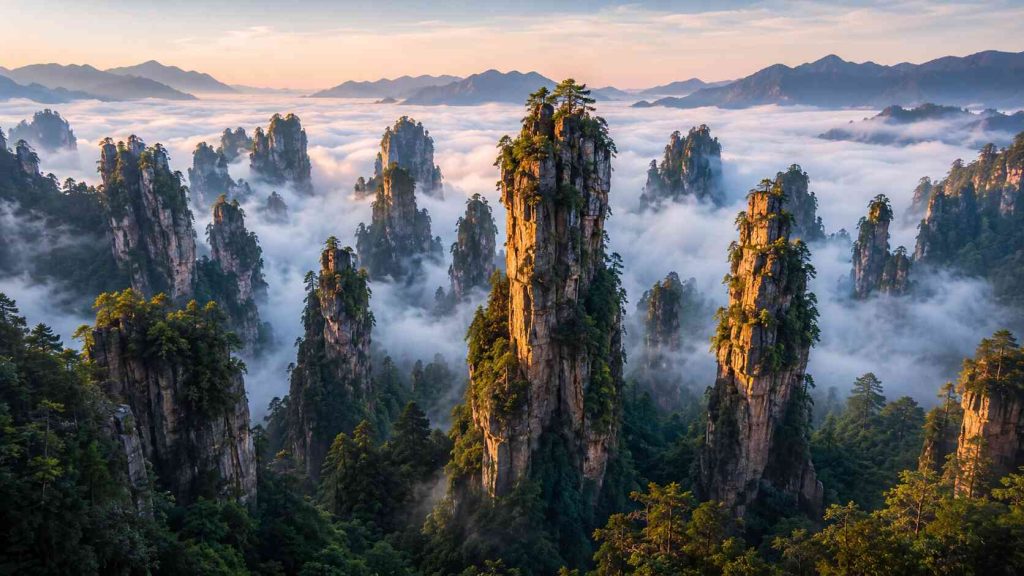
Before James Cameron used them as the visual inspiration for the floating Hallelujah Mountains in Avatar, the sandstone pillars of Zhangjiajie were known mainly to Chinese domestic travelers. The film changed that entirely — and the landscape genuinely deserves the attention. More than 3,000 quartzite sandstone columns rise from the forested valleys of Hunan Province, some exceeding 200 meters in height, many with trees and vegetation growing from their summits. When low clouds fill the valleys and only the peaks of the columns are visible above the mist, the resemblance to something otherworldly is not an exaggeration.
The park’s infrastructure has kept pace with the tourism boom — cable cars, the world’s longest glass bridge (430 meters, suspended between two cliffs at 300 meters altitude), and the Bailong Elevator (the world’s tallest outdoor elevator at 326 meters, built directly into the cliff face) provide access to viewpoints that would otherwise require serious climbing. The hiking trails between the pillars, through valleys full of subtropical forest, are excellent and largely uncrowded outside of Chinese national holidays.
Best time to visit: April–May and October–November (best weather, autumn color in October).
Best for: Adventure travelers, photographers, nature enthusiasts, Avatar fans.
Getting there: Fly to Zhangjiajie Hehua International Airport (DYG), which has connections from major Chinese cities and some international routes.
9. Iceland’s Golden Circle — Geysers, Waterfalls, and Tectonic Plates
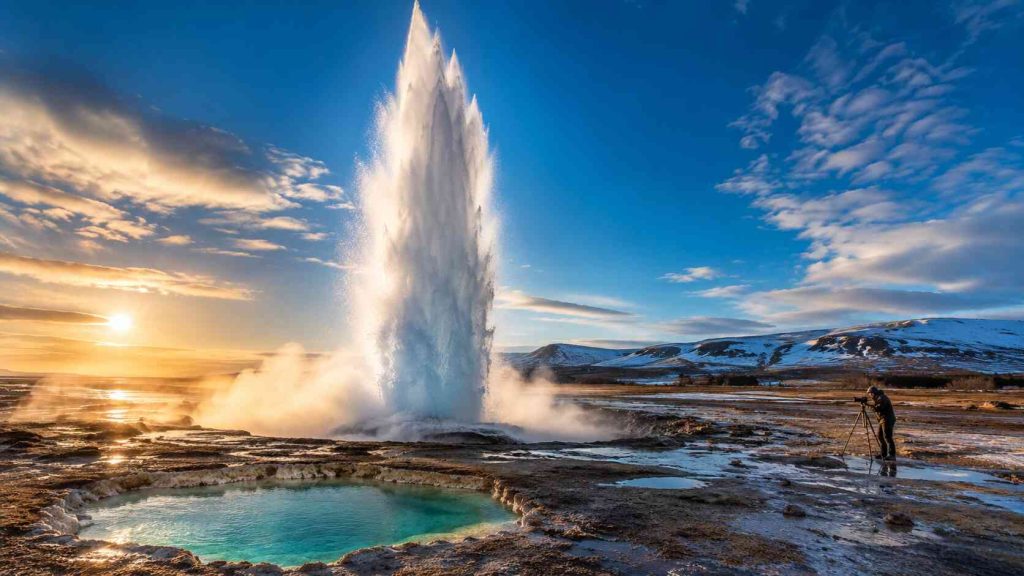
Iceland is the only place on earth where you can stand on the boundary between two tectonic plates — the North American and Eurasian — and see the gap between them with your own eyes. That alone would justify a visit, but Iceland’s Golden Circle route packs several of the country’s most remarkable natural phenomena into a single day’s drive from Reykjavík. Þingvellir National Park sits directly on the Mid-Atlantic Ridge, where the two plates are slowly pulling apart; the rift valley here is also the site of the world’s oldest parliament, founded by Norse settlers in 930 AD.
Geysir geothermal area gives its name to the word “geyser” — the Great Geysir erupted reliably for centuries before becoming dormant, but the nearby Strokkur erupts every 5–10 minutes, shooting a column of boiling water 30 meters into the air with a clockwork regularity that never stops being impressive. Gullfoss, the double-stepped waterfall on the Hvítá river, drops a total of 32 meters into a dramatic canyon that fills with mist and rainbows in the afternoon light. Iceland’s ring road, black-sand beaches, and the possibility of the Northern Lights (September–March) make it one of the most varied natural destinations in Europe.
Best time to visit: June–August for long daylight hours and mild weather; September–March for Northern Lights.
Best for: Nature lovers, geology enthusiasts, photographers, adventure travelers.
Tip: Rent a car — Iceland’s landscapes are best explored independently on your own schedule.
.👉 Also see : Inside Sweden’s ICEHOTEL 365
10. Ha Long Bay, Vietnam — Limestone Karsts on the South China Sea
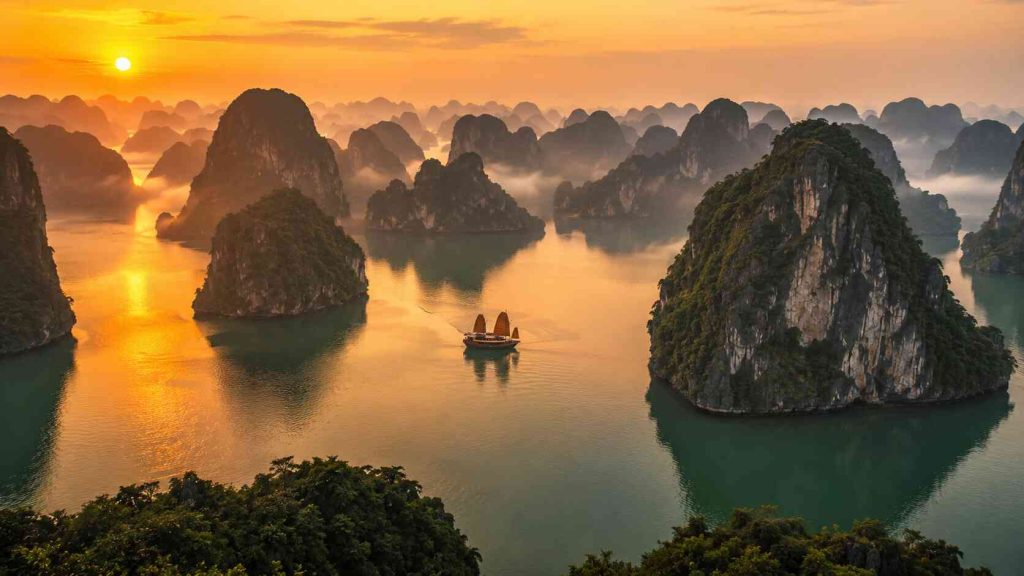
Ha Long Bay in northeastern Vietnam covers 1,553 square kilometers of the Gulf of Tonkin and contains approximately 1,969 islands and islets — most of them uninhabited limestone karst formations that rise vertically from the emerald water like ancient sentinels. The bay was formed over 500 million years by a combination of tectonic activity, tropical erosion, and sea-level changes that carved the limestone into its current dramatic formations. UNESCO recognised it as a World Heritage Site in 1994 for both its geological value and its outstanding natural beauty.
The best way to experience Ha Long Bay is by overnight cruise — a two or three-day journey aboard a traditional junk boat that anchors in quieter corners of the bay away from the day-trip crowds. Better cruise operators access Lan Ha Bay to the south, which is geologically identical to Ha Long but receives far fewer visitors and has better maintained ecosystems. Activities include kayaking through sea caves and hidden lagoons only accessible by water at low tide, swimming in secluded coves, sunrise tai chi on the bow deck, and fresh Vietnamese seafood prepared on board. It is one of Southeast Asia’s most iconic travel experiences done properly.
Best time to visit: October–April (dry season; less humidity, good visibility).
Best for: Couples, families, cruise enthusiasts, photographers, Southeast Asia itineraries.
Tip: Invest in a mid-range or luxury cruise rather than the cheapest option — quality varies dramatically and the boat is your hotel for two nights.
How to Plan a Trip Around Natural Wonders
Natural wonders require more planning than city breaks. Most are in remote locations, subject to weather conditions, and protected by entry limits or permit systems that can’t be bypassed at the last minute. Here’s what to keep in mind:
- Book permits early. Machu Picchu’s Inca Trail, Antelope Canyon tours, and Ha Long Bay’s best cruises all sell out weeks or months ahead in peak season. This is not an exaggeration — plan accordingly.
- Time your visit around weather, not just convenience. Salar de Uyuni’s mirror effect only happens during the wet season. The Great Barrier Reef has a stinger season. Antelope Canyon’s light beams only appear at specific times of year. The destination dictates the timing, not the other way around.
- Arrive early. At almost every destination on this list, the first two hours after opening are dramatically better than midday. Fewer people, better light, and the experience of standing somewhere extraordinary without a crowd around you is worth the early alarm.
- Travel responsibly. These places exist because of active conservation efforts. Stay on marked trails, use licensed guides where required, choose eco-certified operators for marine destinations, and leave no trace. The travelers who came before you kept these places intact — extend the same courtesy to the ones who come after.
Frequently Asked Questions
What are the most beautiful natural wonders in the world?
By sheer visual impact, Salar de Uyuni’s rainy-season mirror effect, Antelope Canyon’s light beams, Plitvice Lakes’ turquoise waterfalls, and the sandstone pillars of Zhangjiajie consistently rank among the most photographed and most emotionally powerful natural destinations on earth. The Great Barrier Reef and Ha Long Bay add marine and coastal dimensions that no land-based destination can replicate.
Which natural wonder on this list is easiest to visit?
Santorini and Iceland’s Golden Circle are the most logistically straightforward — well-served by international flights, with excellent infrastructure and English widely spoken. Banff National Park is easy to access from Calgary International Airport. Antelope Canyon requires a domestic US flight to Phoenix or Las Vegas and a drive, but the tour itself is a half-day commitment.
Which is better for families — Banff or the Great Barrier Reef?
Both are excellent for families. Banff offers more varied activities across age ranges — hiking, wildlife spotting, skiing, kayaking — and has no specific safety concerns. The Great Barrier Reef requires children to be strong swimmers for snorkeling, and the jellyfish (stinger) season from October to May limits safe swimming in some areas. For younger children, Banff is the safer and more versatile choice.
Is it safe to visit Machu Picchu with altitude sickness concerns?
At 2,430 meters, Machu Picchu itself sits at a relatively manageable altitude — most healthy travelers acclimatize without significant issues. The challenge is Cusco (3,400m), which is the standard gateway city, and the Inca Trail, which crosses passes above 4,200m. Spending 2–3 days in Cusco before visiting the site, staying well hydrated, and ascending gradually reduces the risk considerably. Consult a doctor about altitude medication (acetazolamide) if you have concerns.
What is the best natural wonder for photography?
Antelope Canyon is the most technically rewarding for photography — the interplay of light and sandstone at midday creates conditions unlike anywhere else. Salar de Uyuni during the rainy season mirror effect is the most dramatic for wide-angle landscape work. Plitvice Lakes in autumn (October) combines waterfall photography with exceptional foliage color. All three reward patience and early arrival.
Final Thoughts
Natural wonders don’t care about trends, seasons, or Instagram algorithms. They were extraordinary before we arrived to photograph them and will remain so long after. What they offer — a genuine sense of scale, of geological time, of the planet operating on forces and timelines that dwarf human experience — is increasingly rare in a world of curated experiences and manufactured spectacle.
Pick one destination from this list. Plan it properly. Go at the right time of year. Arrive early. And put the camera down for at least five minutes when you get there.
Some things deserve to be experienced first, documented second.