
Fiji was never the plan.
When most people start researching overwater bungalows, they go straight to the Maldives. That is where the algorithm sends you. That is where the honeymoon boards on Pinterest point. The Maldives has better marketing, more name recognition, and a decade-long head start in the global luxury travel conversation.
But then, somewhere in the research rabbit hole, Fiji appears. And specifically, Likuliku Lagoon Resort appears. And suddenly the Maldives starts to feel like a very obvious choice.
That is not a criticism of the Maldives. It is an observation about what Likuliku does to you when you find it. It unsettles your plan. It raises a question you did not expect to be asking: what if the best overwater bungalow experience in the South Pacific is not the one everyone talks about?
This review is the answer to that question. It is based on deep research across hundreds of guest accounts, detailed study of the property’s structure and surroundings, and direct comparison with the best overwater resorts in the world — including the properties we covered in our complete guide to the best overwater bungalows in the world. If you’re still weighing Fiji against the Maldives and Bora Bora, our full destination comparison covers the decision in detail: Bora Bora vs Maldives vs Fiji — Which Paradise Is Right for You?
At a Glance
| Detail | Info |
|---|---|
| Location | Malolo Island, Mamanuca Archipelago, Fiji |
| Villa Count | 45 bures (10 overwater, 35 beachfront) |
| Transfer | 50-min catamaran or 15-min helicopter from Nadi |
| Adults Only | Yes — no guests under 17 |
| Best For | Honeymoons, couples, serious snorkelers |
| Price Range | From ~$1,200–$2,500+ per night |
| Dining | All meals included (3 gourmet meals daily) |
| Ownership | 100% Fijian family owned |
| Marine Status | Protected marine sanctuary lagoon |
| Best Season | May–October (Fiji dry season) |
What Is Likuliku Lagoon Resort?
Likuliku Lagoon Resort sits on Malolo Island in the Mamanuca archipelago, about 25 kilometres west of Nadi on Fiji’s main island of Viti Levu. It is an adults-only resort — no guests under 17 — with 45 bures in total. Ten of them are overwater. The remaining 35 are beachfront, all within a short walk of the lagoon.
That “adults only” detail matters more than it might initially seem. It shapes the atmosphere of the entire property. There are no running children at the pool. No early-morning noise from neighboring families. The pace is deliberately unhurried, and the resort actively protects that quality. Couples come here for that reason as much as for the bures themselves.
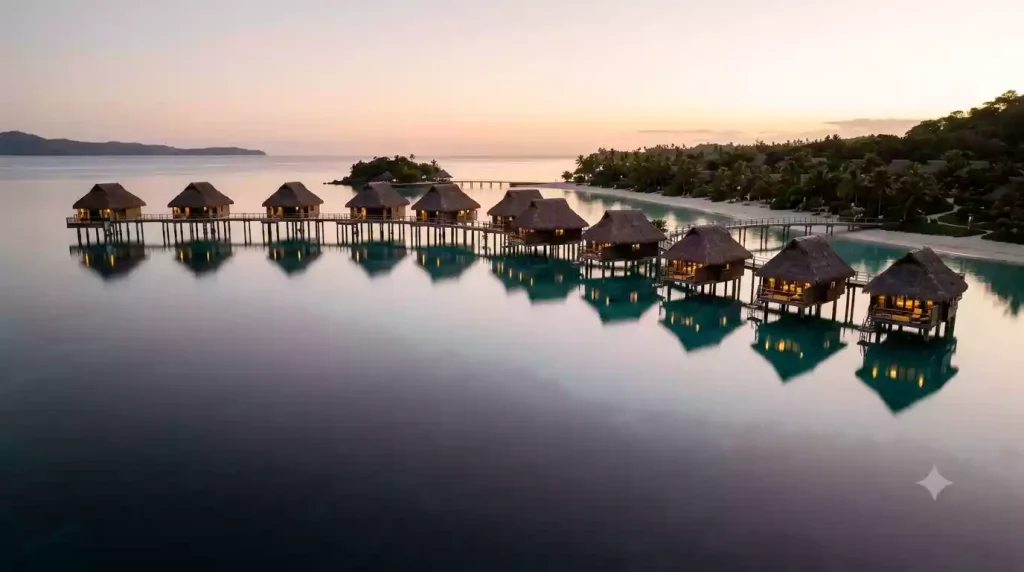
What makes Likuliku genuinely unique is a fact most competitor resorts would prefer you not to know: it is the only resort in Fiji with authentic overwater bures. Not overwater rooms in the Maldivian sense, not elevated water villas in the Polynesian sense — but traditional Fijian bures, built from locally sourced hardwood and natural materials, suspended over a protected marine sanctuary lagoon. There is nothing else like it in the country.
The resort is also 100% Fijian family owned. That fact is not decorative. It has real consequences for how the property feels, how the staff behave, and how deeply the Fijian cultural experience is woven into the stay.
Getting There — The Journey Is Part of It
You fly into Nadi International Airport. From there, you have four options to reach Malolo Island: catamaran, private speedboat, seaplane, or helicopter. The catamaran via South Sea Cruises is the most economical choice — approximately 50 minutes from Port Denarau Marina, operating three times daily. A resort tender meets the catamaran at a nearby jetty and brings you the final stretch to Likuliku. This is the route most guests take, and it works perfectly well.
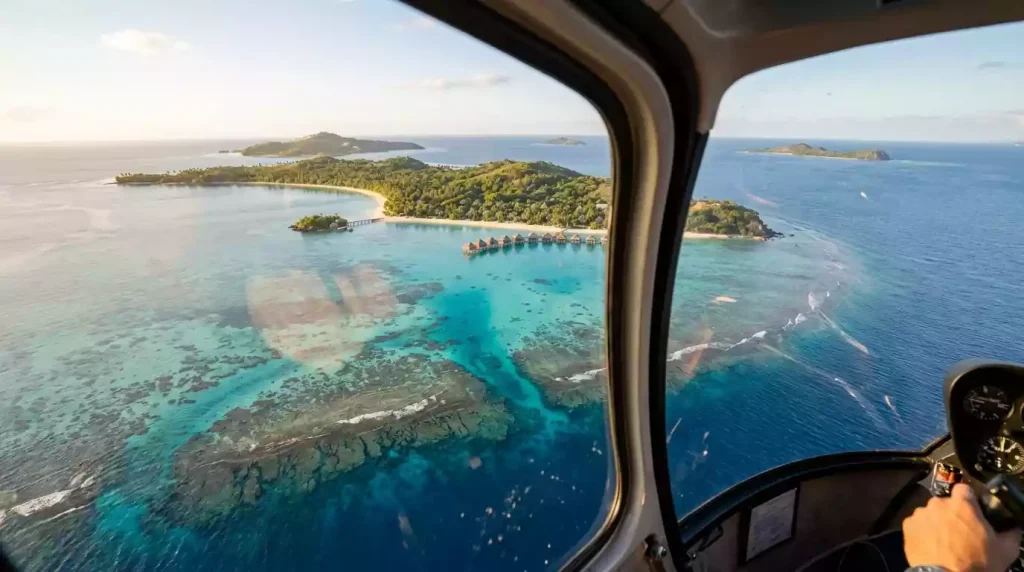
The helicopter takes 15 minutes and costs significantly more. However, it delivers something the catamaran cannot: a view of the Mamanuca Islands from above that reframes everything you are about to experience at water level. The coral formations, the gradient of color from deep ocean to shallow lagoon, the scale of the island chain — all of it becomes legible from the air in a way it never quite is from a boat. If budget allows, take the helicopter at least one way. Many guests choose to arrive by speedboat and depart by helicopter to have both perspectives without paying twice. For stays of seven nights or more in low season (roughly November to March), helicopter transfers are often included in the package rate.
One practical note: helicopter services operate in daylight hours only and are subject to weather. Schedule your international arrival into Nadi with sufficient buffer — at least three hours before any onward transfer — to accommodate delays without stress. For help with flight routing into Nadi: How to Find Cheap Flights and Hotel Deals.
Accommodation
The Overwater Bures — What 60 Square Metres Above a Lagoon Actually Feels Like
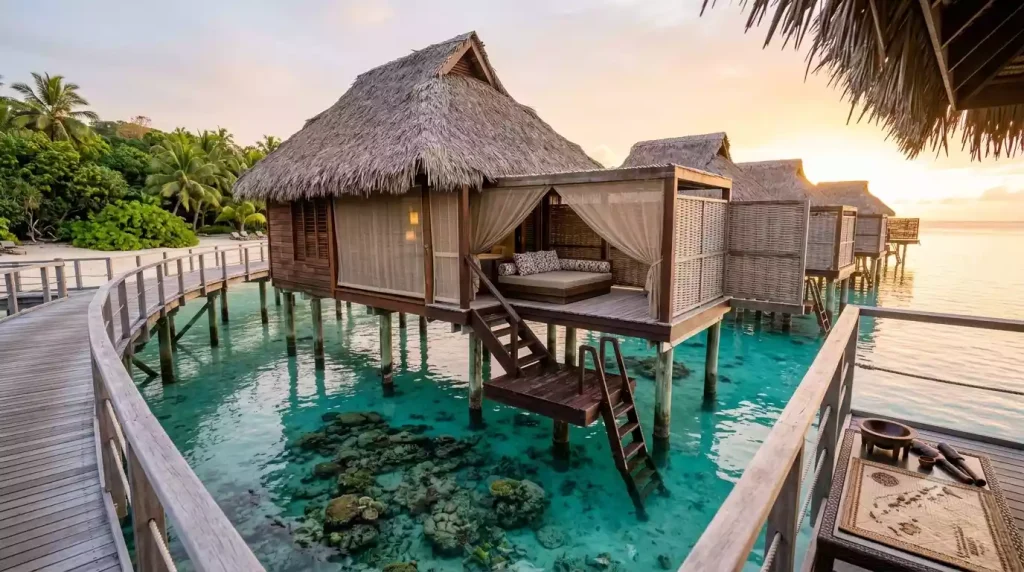
There are 10 overwater bures at Likuliku. That is a small number by Maldivian standards — resorts in the Indian Ocean often have 50, 80, even 100 overwater units. But the restraint here is deliberate, and it shows. Each bure measures 60 square metres of interior space, with an additional 31 square metres of deck. The deck is screened on the sides for privacy between neighbouring bures — a detail that many overwater resorts fail to get right and Likuliku handles thoughtfully. From the deck, the view is open lagoon. Nothing between you and the water.
The bures are constructed from locally sourced hardwood and traditional Fijian materials. No concrete. No imported fittings that feel disconnected from the surroundings. The interior uses natural textures throughout — woven panels, timber floors, thatch detailing — in a way that produces a room that is genuinely beautiful rather than merely expensive-looking.
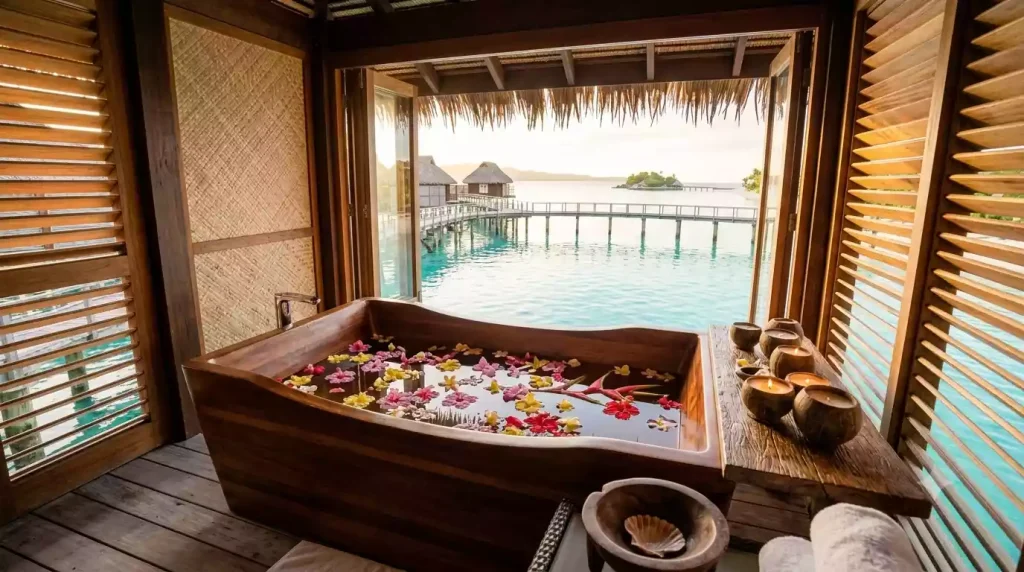
Each overwater bure includes a king-size bed, air conditioning, music system, flatscreen TV, WiFi, and an in-bure espresso machine with pods replenished daily. The separate bathing pavilion — a feature unique to the overwater bures — has a bathtub with lagoon views. Sitting in that bath, looking directly out at the water, is one of those small moments that guests mention in reviews with unusual frequency. At the lower end of the deck, a short ladder descends directly into the lagoon — a protected marine sanctuary where coral health beneath the overwater bures is consistently described as excellent, with diverse reef fish, blacktip reef sharks in the shallows, and visibility that makes stepping off the ladder feel like stepping into a wildlife documentary.
One important thing to know before you book: Likuliku sits in a natural tidal lagoon. Fiji experiences lunar tides, which means the depth of water at your bure ladder varies depending on the moon phase during your stay. At certain tidal low points, the water is shallow rather than deep. This surprises some guests who expected Maldivian-style consistent depth. It is not a flaw — it is a feature of a genuine natural environment rather than a manicured resort lagoon — but it is worth knowing in advance.
For a comparison of how Likuliku’s overwater bures stack up against the world’s other overwater properties: Best Overwater Bungalows in the World.
The Beachfront Bures — The Option More People Should Consider
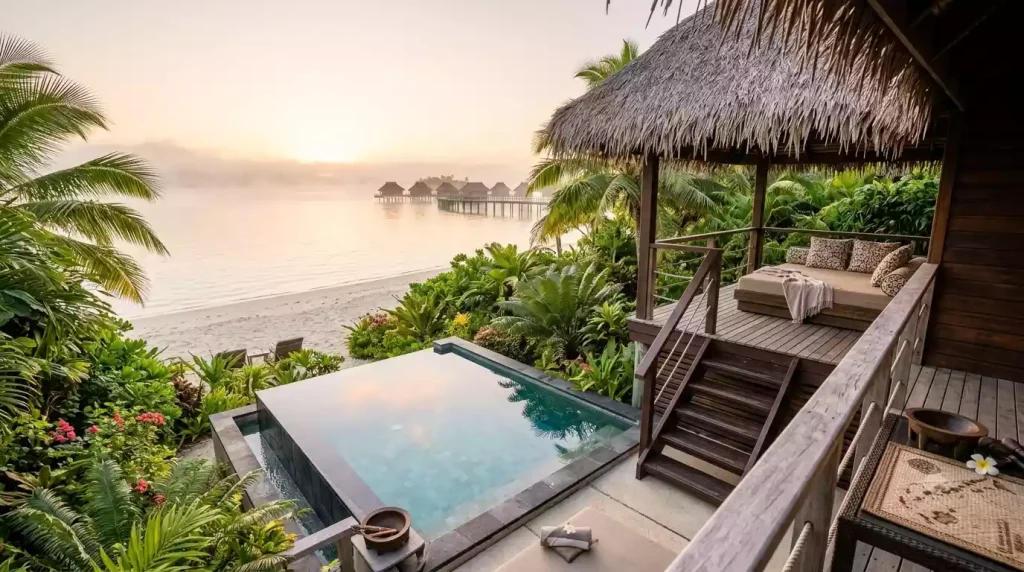
Here is something that overwater bungalow coverage rarely says honestly: for many guests, the beachfront bures at Likuliku are the better choice. The Deluxe Beachfront Bures have private plunge pools — the overwater bures do not. They are split-level, with bedroom, living area, daybeds, and patio clearly separated — more functional space than the overwater bures provide. And the beachfront position means direct beach access in addition to lagoon access, rather than the lagoon alone.
The overwater bures deliver something the beachfront cannot: that specific feeling of suspension above the water, of the reef moving beneath your floor, of stepping directly from your private deck into the lagoon. For many guests, that experience is the entire reason they chose Likuliku. But if you have any doubt: the snorkeling off the main jetty at Likuliku is, according to consistent guest accounts, as good as the snorkeling from the overwater bure deck. The reef is the reef. The access point matters less than the destination.
You May Also Like
Dining — All-Inclusive Done Properly
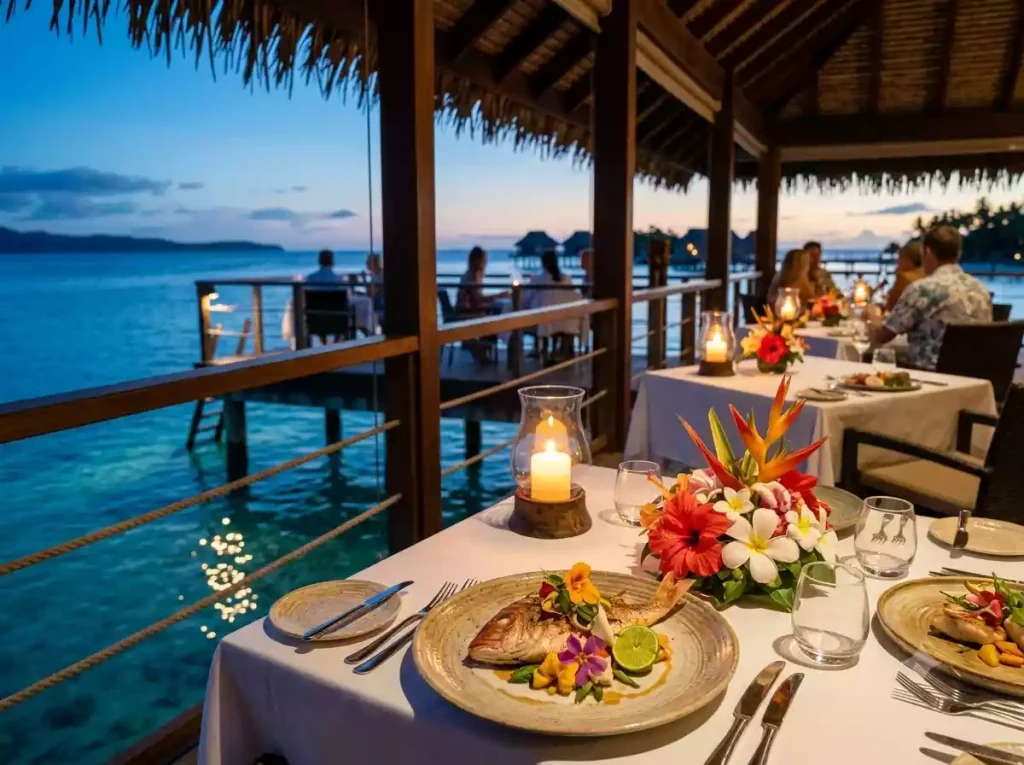
The meal inclusion at Likuliku — three gourmet meals per day, plus a poolside lunch menu — is one of the most underrated aspects of the resort’s value proposition. Most travellers associate all-inclusive dining with a trade-off in quality. Likuliku disproves that assumption consistently.
The Fijiana Restaurant is the main dining venue. The menu changes daily, built around fresh local seafood, Fijian produce, and a culinary approach that draws on Fijian, Chinese, and Indian influences — a reflection of the actual cultural history of Fiji rather than a generic “Pacific cuisine” template. Breakfast runs both à la carte and buffet, with fresh tropical fruit of a quality that most urban supermarkets cannot approximate. Lunch is a multi-course affair starting with an amuse-bouche and a chilled tropical drink. Dinner is similarly structured.
The Saluwaki is the resort’s intimate concept-dining restaurant, available for one dinner per stay as part of the inclusion. It seats a small number of guests in a more private setting, with a menu that leans into locally inspired flavours with more focus and intention than the main restaurant. Most guests who do Saluwaki describe it as a highlight of the trip.
The Masima Island Bar deserves its own mention. It sits on a small islet in the middle of the lagoon — a bar literally surrounded by water — and it is where the resort’s personality becomes most visible. Order a coco mojito made with fresh coconut, find a spot, and watch the water. The evening light on this lagoon, particularly in the hour before sunset, has a quality that guests struggle to describe accurately and return to describe in reviews anyway. A practical note: the meal inclusion covers food, but alcohol is generally at additional cost. Budget accordingly.
The Fijian Culture — What Makes This Place Different From Every Other Luxury Resort
This is the section that matters most for understanding why Likuliku Lagoon Resort occupies a category of its own. Consider what our Four Seasons Bora Bora review noted about cultural experience at luxury resorts: that the cultural texture of a Fijian overwater stay is genuinely different — less formal than the Maldives, more authentic than the performance that very expensive resorts can produce. Likuliku is the specific evidence for that observation.
The resort is wholly owned by a Fijian family. Every member of staff is local. The architecture follows traditional Fijian village design — from a distance on the water, the resort looks like an ancient Fijian settlement, not a luxury hotel. The central building is modelled on a traditional canoe house. This is not decorative. It reflects a genuine design philosophy that prioritised cultural integrity over generic luxury signalling.
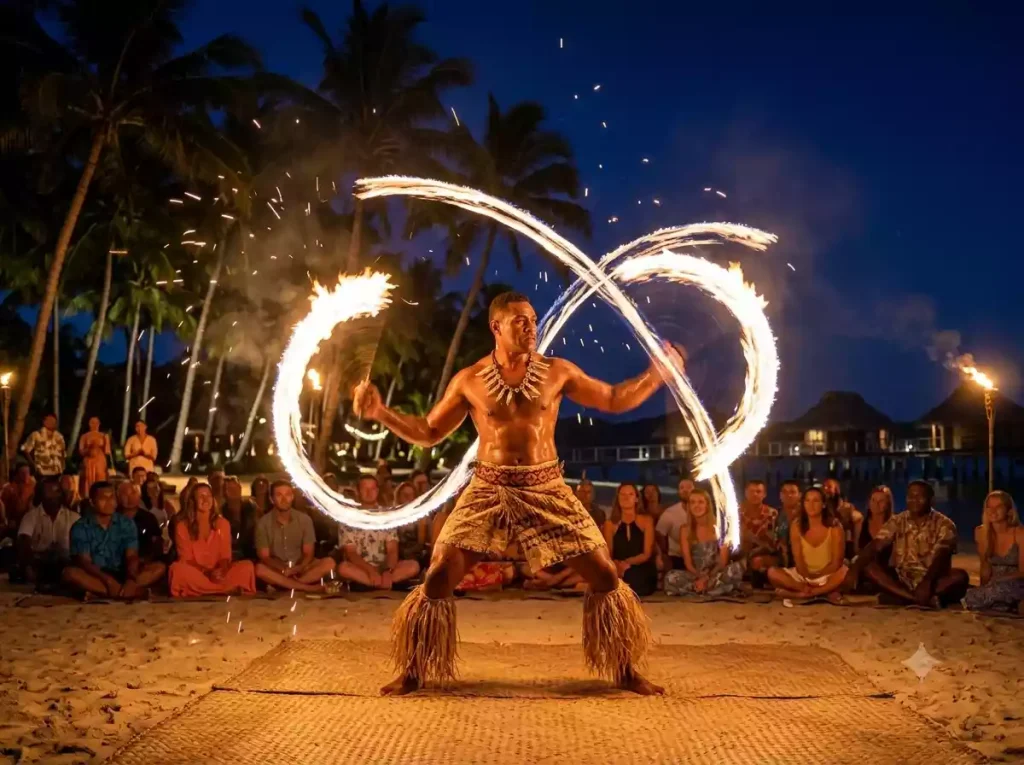
The cultural programming here is also real rather than performative. Tuesday nights bring a kava ceremony — guests sit with staff, learn the proper protocol for receiving and drinking kava, and participate in something that has been practised on these islands for centuries. It is not a tourist show. It is an invitation into an actual tradition. Friday nights bring the Management Cocktail Party and Fijian Cultural Show. Monday nights feature fire and dance from the South Pacific.
Village tours to Solevu and Yaro are available, giving guests direct access to the communities whose islands these have been long before any resort existed. Hikers can reach Jona’s Lookout, which offers panoramic views of the entire lagoon and the surrounding Mamanuca chain.
When guests describe Likuliku’s staff in reviews, the word that appears most consistently is not “professional” or “efficient.” It is “warm.” That quality is a function of the Fijian concept of kerekere — a cultural value of generosity and reciprocity that runs through how Fijians engage with guests. You cannot manufacture it. You can only create the conditions for it to exist. Likuliku, because it is Fijian-owned and Fijian-run, has those conditions in ways that international chain resorts simply do not.
The Marine Sanctuary — Why the Reef Matters
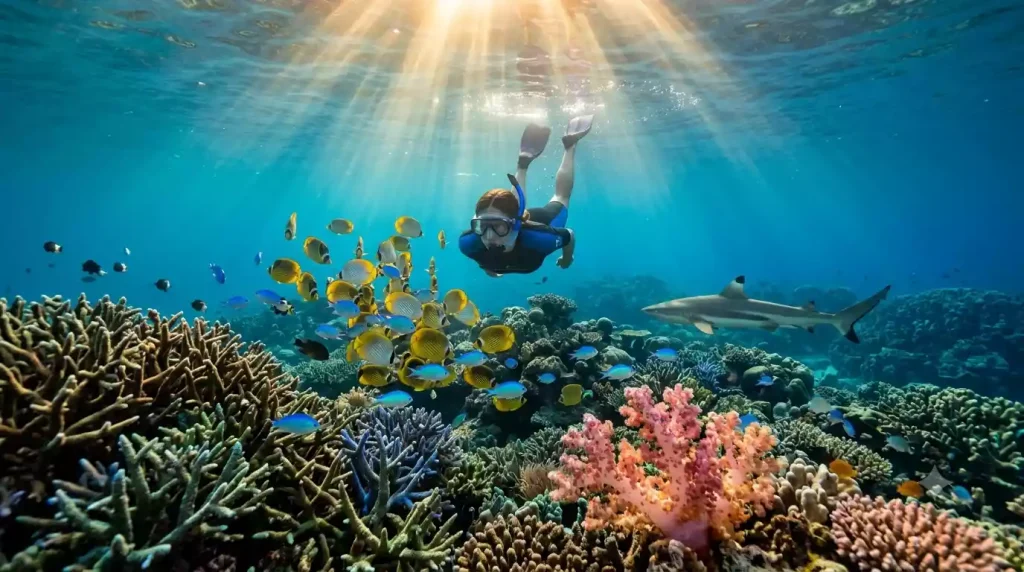
Likuliku sits within a protected marine sanctuary. That designation has real consequences for what you experience in the water around the resort. The reef health here is consistently excellent — colourful hard and soft corals in good condition, abundant fish life, reef sharks in the shallows, and visibility that frequently exceeds 20 metres. This is not a reef that has been loved to death by decades of resort guests. The marine sanctuary protection means the ecosystem has space to recover and maintain itself.
The resort has access to 44 dive sites around Malolo Island. Dive operations are run by specialist PADI operators who know these sites intimately. If you dive, this is a destination that rewards you — the marine diversity around the Mamanuca Islands is exceptional, with manta ray encounters possible during the right season and regular sightings of reef sharks, eagle rays, and pelagic species.
The honest comparison with the Indian Ocean: the Maldives — particularly Baa Atoll — edges ahead for pure marine biodiversity at the most remote atolls. But Likuliku’s reef is genuinely excellent, and the protected status gives it a long-term quality that resorts in high-traffic areas cannot guarantee. For underwater hotel experiences that push the marine immersion concept further, see: Most Beautiful Underwater Hotels in the World.
Activities — More Than You Would Expect
Likuliku is sometimes described as a “do nothing” resort, and doing nothing here is genuinely possible — the lagoon, the deck, the sun, the bar, repeat — without any sense that you are missing something. But the activity offering is more substantive than that description implies.
Beyond diving and snorkeling from the house reef, the resort offers kayaking through the lagoon and across to the nearby sandbar, stand-up paddleboarding, outrigger canoe trips, guided village walks, and the cultural programming described above. The Tatadra Spa is built into the island’s green slopes, using the natural topography rather than imposing a spa footprint on the landscape. Treatments draw on indigenous Fijian ingredients — dilo oil, a traditional remedy with significant moisturising properties, is the signature element. For couples building a honeymoon itinerary, a couples’ treatment at Tatadra — ideally timed for mid-afternoon when the light through the spa’s natural screening is at its most beautiful — appears in the “best moments of the trip” section of guest reviews with notable regularity.
Service
The 100% local staffing model at Likuliku is the foundation of a service experience that consistently outperforms what the property’s price point might suggest. Fijian hospitality — genuine, warm, specific to the person rather than to the role — is something that resort operators around the world spend considerable effort trying to replicate through training programmes. At Likuliku, it requires no replication because it is simply what the staff bring from their own culture. The ratio of staff to guests is high, the turnover is low (many staff have been at the resort since opening), and the result is service delivered by people who know the property and its guests rather than people rotating through a training programme.
Value for Money
Likuliku’s rates start from approximately $1,200 per night for a beachfront bure and reach $2,500+ for the overwater category. The all-inclusive meal package — three meals daily at a standard considerably above what “all-inclusive” usually implies — narrows the effective cost gap with non-inclusive alternatives significantly. When a couple accounts for dining, activities, and transfers that are built into the Likuliku rate versus charged separately at comparable Maldives properties, the total trip cost comparison is considerably more favourable to Likuliku than the headline rate suggests.
The comparison with the Soneva Jani and Gili Lankanfushi in the Maldives is instructive: Likuliku’s entry rate is lower than both, the cultural dimension is richer, and the marine sanctuary reef competes credibly with North Malé Atoll. The Maldives properties offer more dramatic overwater villa architecture (Soneva Jani’s retractable roof, Gili Lankanfushi’s Crusoe Residence hammock net), more remote atoll settings, and in some cases more developed activity programmes. Neither is a clear “better” answer — they are different answers to different versions of the same question.
For guests whose budget extends further and who want the complete Fiji private island experience with all-inclusive dining and Great Astrolabe Reef diving, Kokomo Private Island is the natural next step up from Likuliku in the Fiji luxury hierarchy — a full private island at approximately $2,500–$8,000 per night, with the Great Astrolabe Reef on the doorstep and a maximum of 60 guests on 140 acres.
For honeymoon planning context and how Likuliku compares across the full spectrum of options: Best Honeymoon Destinations in the World.
Pros and Cons
- ✅ Only resort in Fiji with authentic overwater bures — genuinely unique in the country
- ✅ 100% Fijian family owned — the warmth and cultural authenticity this produces is not replicable by international chains
- ✅ All meals included at a quality that defies the all-inclusive category
- ✅ Protected marine sanctuary lagoon — reef health genuinely excellent and sustainably maintained
- ✅ Adults-only — the atmosphere this creates is a meaningful part of the experience
- ✅ Strong value proposition once all-inclusive meals are factored against non-inclusive alternatives
- ✅ Masima Island Bar — genuinely one of the most atmospheric resort bars in the Pacific
- ❌ Only 10 overwater bures — books out far in advance, particularly for peak season
- ❌ Tidal lagoon — water depth at bure ladders varies with moon phase, not consistent like Maldives resort lagoons
- ❌ Overwater bures have no private plunge pool (beachfront bures do)
- ❌ Alcohol not included in the meal package — drinks bill adds up at Masima
- ❌ Catamaran transfer takes 50 minutes — not the most glamorous arrival for a property at this price point
Who Should Stay at Likuliku Lagoon Resort
Honeymooners who want an overwater bure experience with genuine Fijian cultural depth rather than a hermetically sealed luxury resort will find Likuliku the most satisfying answer in the South Pacific. Couples returning to the Maldives-style experience who want something different will find that Likuliku’s warmth, reef quality, and cultural programming offer a genuine alternative. Snorkelers and divers who want a protected reef accessible directly from the property, with 44 dive sites within range, will not feel they’ve compromised on the marine experience.
It is not the right choice for travelers who need a plunge pool on the overwater villa (consider a beachfront bure instead, or look at Kokomo Private Island for more comprehensive villa features). It is not designed for families — the adults-only policy is firm. And it is not the best choice for guests whose primary motivation is the most dramatic overwater villa architecture available anywhere — for that, Soneva Jani’s retractable bedroom roof or Gili Lankanfushi’s Crusoe Residence set the standard.
How We Evaluated This Resort
This review assesses Likuliku Lagoon Resort across seven criteria applied consistently across all Plishere hotel reviews: location (accessibility, reef quality, island setting); accommodation quality (bure design, authenticity of materials, unique features, tidal considerations); dining (all-inclusive quality, variety, standout experiences); service (staff quality, local ownership model, cultural authenticity); facilities (spa, diving, cultural programming, activities); guest experience (what makes this property genuinely different from its competitors); and value for money (all-inclusive rate versus non-inclusive alternatives, total trip cost comparison). Assessment draws on verified guest accounts, editorial travel coverage, and direct property information current to 2026.
Frequently Asked Questions
Where is Likuliku Lagoon Resort located?
Likuliku Lagoon Resort is located on Malolo Island in Fiji’s Mamanuca archipelago, approximately 25 kilometres west of Nadi on the main island of Viti Levu. It is accessible by catamaran (50 minutes from Port Denarau Marina), speedboat, seaplane, or helicopter (15 minutes).
Is Likuliku Lagoon Resort adults only?
Yes — no guests under 17 are permitted. This is one of the resort’s defining characteristics and the primary reason the atmosphere is as unhurried and romantic as it consistently is.
How much does Likuliku Lagoon Resort cost per night?
Beachfront bures start from approximately $1,200 per night. Overwater bures from approximately $1,800–$2,500 per night. Rates include three meals daily. Alcohol and some activities are charged separately. Low-season rates (November–March) are typically 20–30% lower than dry-season peak rates.
Is Likuliku Lagoon Resort all-inclusive?
The rate includes three gourmet meals daily (breakfast, lunch, and dinner) at a quality significantly above the typical all-inclusive standard. Alcohol, premium spa treatments, diving, and helicopter transfers are generally charged separately. Confirm exact inclusions for your specific rate at booking as packages vary.
What makes Likuliku Lagoon Resort unique in Fiji?
It is the only resort in Fiji with authentic overwater bures — traditional Fijian bures built from locally sourced hardwood and natural materials, suspended over a protected marine sanctuary lagoon. It is also 100% Fijian family owned and staffed entirely by local Fijians, which produces a cultural authenticity that international chain resorts cannot replicate.
Is the overwater bure or beachfront bure better at Likuliku?
It depends on priorities. The overwater bure delivers the suspension-above-water experience, lagoon-level snorkel access, and the distinctive bathing pavilion with lagoon views. The beachfront Deluxe Bures have private plunge pools (the overwater bures do not), more functional living space, and direct beach access. For guests who specifically want the overwater experience, the bure is worth the premium. For guests with any doubt, the beachfront bure is genuinely competitive — and the snorkeling from the main jetty is, by most guest accounts, as good as from the overwater bure deck.
What is the best time to visit Likuliku Lagoon Resort?
May through October — Fiji’s dry season — offers the best weather, calmest seas, and clearest snorkeling and diving visibility. The overwater bures book out well in advance for June–September. November through March is the wet season — rates are lower, but tropical rain is more frequent and sea conditions less predictable.
How does Likuliku compare to the Maldives?
Likuliku is more accessible (boat transfer rather than seaplane), culturally richer (Fijian family owned, authentic local programming), and lower in total cost once all-inclusive meals are factored against Maldives resorts where dining is charged separately. The Maldives — particularly Soneva Jani and Gili Lankanfushi — offers more dramatic overwater villa architecture and more remote atoll settings. Neither is objectively better — they suit different priorities. Full comparison: Bora Bora vs Maldives vs Fiji.
Does Likuliku have good snorkeling?
Yes — the resort sits within a protected marine sanctuary, which keeps the reef in excellent condition. Blacktip reef sharks in the shallows, diverse coral fish populations, and good visibility (frequently exceeding 20 metres) are consistent guest reports. Snorkeling is accessible from the overwater bure decks and from the main resort jetty, with the jetty access being equally good by most accounts.
Is Likuliku Lagoon Resort good for a honeymoon?
Yes — it is one of the Pacific’s most consistently recommended honeymoon properties. The adults-only policy, the cultural warmth of the Fijian staff, the overwater bure setting, the all-inclusive dining quality, and the Masima Island Bar at sunset combine to produce a honeymoon experience with genuine emotional texture rather than just luxury accommodation. For the full honeymoon destination comparison: Best Honeymoon Destinations in the World.
Final Verdict
Likuliku Lagoon Resort earns its reputation not through spectacle but through specificity. The overwater bures are not the largest in the Pacific. The resort is not the most remote. The price is not the highest. What it offers is something more durable than any of those metrics: a genuinely Fijian experience at a luxury level, delivered by people for whom the warmth is cultural rather than contractual, in a setting where the reef is protected because the people who run the resort live on this island and their community depends on its health.
That combination — authentic culture, marine sanctuary, all-inclusive quality, and a property that knows exactly what it is and delivers it consistently — is rarer in the South Pacific luxury market than the volume of overwater bungalow options suggests. Likuliku found the answer. The question was Fiji’s.
👉 Continue exploring Fiji and Pacific luxury: Kokomo Private Island Fiji Review | Bora Bora vs Maldives vs Fiji | Best Overwater Bungalows in the World | Best Honeymoon Destinations in the World