
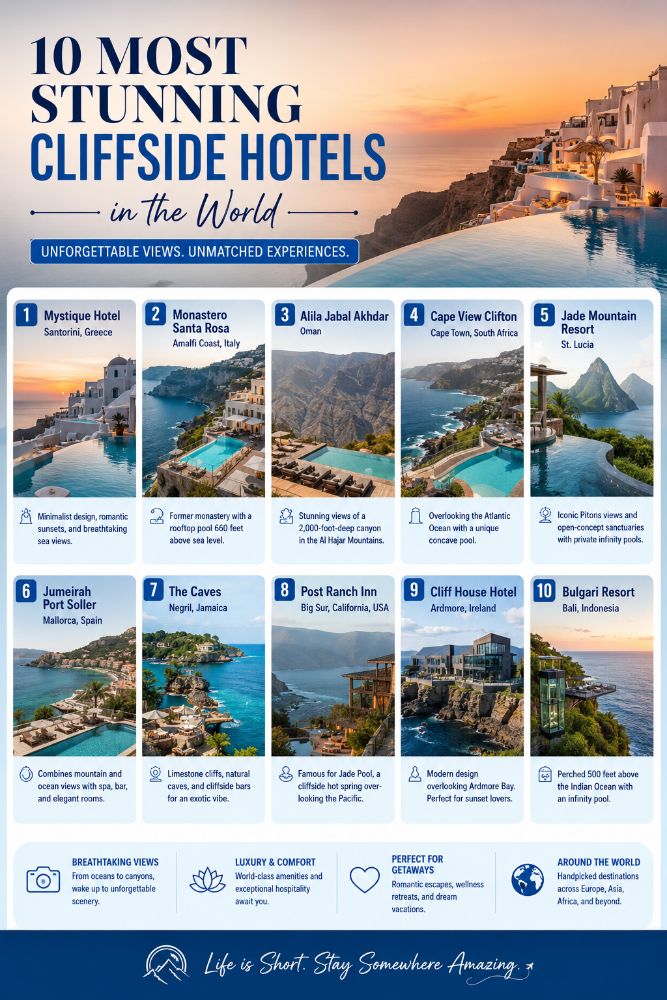
A room with a view is one of travel’s most overused phrases. But there is a specific category of hotel where that phrase stops being marketing language and starts being a literal description of something you can’t quite believe is real.
Cliffside hotels are that category.
There is something fundamentally different about a room positioned at the edge of something dramatic — a volcanic caldera, a Pacific coastline, an ancient mountain canyon. The view is not a bonus. It is the point. The cliff is not background. It is the reason the hotel exists, the reason guests return, and the reason photographs from these properties spread faster than almost anything else in travel.
This list covers ten of the world’s most extraordinary cliffside hotels. Not ten properties selected because they look good on Instagram — but ten that have a legitimate claim to the title based on the quality of their setting, the standard of their accommodation, and the honesty of what they actually deliver once you arrive. We’ve included the honest details on what each property does well and where the experience has real limitations, because at these prices, that information matters.
These are not ranked. Every property on this list is exceptional in its own way, and the right choice for you depends on what kind of dramatic landscape speaks to you most.
1. Mystique Hotel — Santorini, Greece
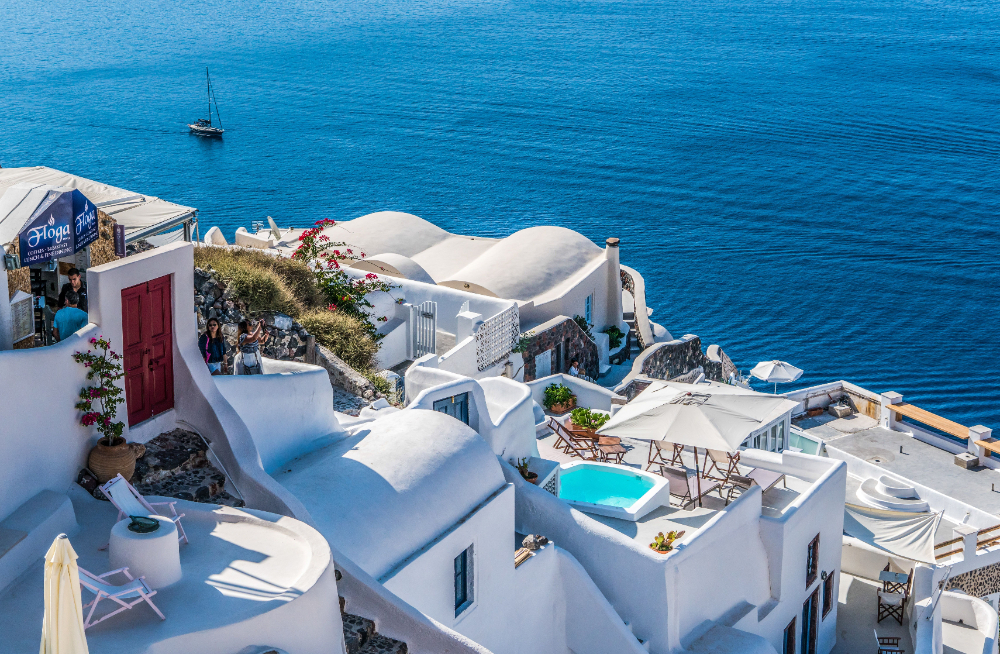
The cliff that launched a thousand mood boards.
If there is one cliffside hotel that has defined what the category looks like in the modern traveler’s imagination, it is Mystique. Perched on the volcanic caldera rim at Oia, it sits at the edge of one of the most photographed landscapes on earth — the white-and-blue silhouette of Santorini, falling steeply into the deep blue Aegean below.
Mystique’s design is considered and restrained in a way that its competitors sometimes are not. The 41 suites and villas use a minimalist palette — whitewashed walls, dark volcanic stone floors, clean lines — that complements rather than competes with the view. The infinity pool appears to dissolve directly into the caldera below, an effect that works even after you’ve seen it fifty times in photographs and is somehow still more striking in person.
What makes Mystique particularly worth considering is the layout. The property is carved into the caldera face in terraces, which means most suites have genuine seclusion from their neighbors rather than the crowded overwater-bungalow problem of being able to hear the couple next door. The caldera-facing suites are the right choice here — the garden-facing alternatives save money but miss the point entirely.
The honest caveat: Santorini in peak season (July–August) is genuinely crowded, and the area around Oia gets uncomfortably busy. Mystique’s private setting helps, but arriving in May, June, or September meaningfully improves the experience and usually reduces the room rate.
- Best for: Couples, honeymooners, first-time Santorini visitors
- Price: From approx. $800–$1,200/night depending on season
- The detail worth knowing: Sunset at Oia is famous for good reason — book dinner on your terrace rather than competing for space in town
If you have already visited the Grace Hotel on Santorini’s Imerovigli caldera — which we covered in our Grace Hotel Santorini review — Mystique offers a slightly different character: more intimate in scale, more focused on the villa experience rather than the social atmosphere of the pool and bar areas.
2. Monastero Santa Rosa — Amalfi Coast, Italy
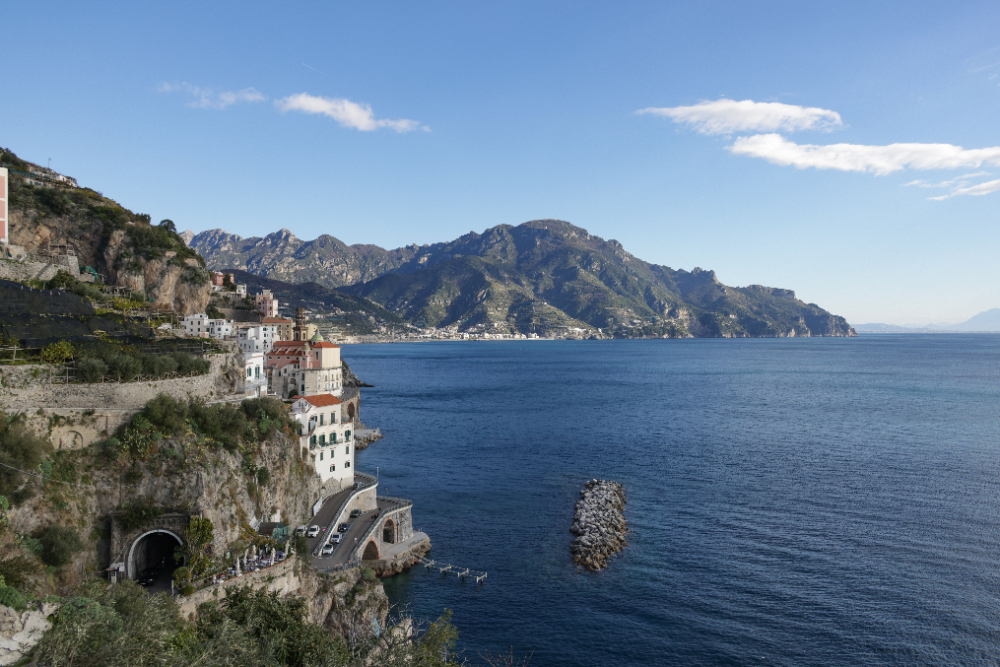
The one that makes every other hotel feel like it wasn’t trying hard enough.
There is a moment that appears consistently in guest accounts of Monastero Santa Rosa. It happens when you step out from the converted monastery into the terraced gardens and realize that the whole structure is hanging over the Amalfi Coast at 660 feet above sea level, with nothing between you and the Tyrrhenian Sea except the edge of a cliff that has been there since the 17th century.
The hotel was a Dominican monastery until the early 20th century, and the bones of that history are everywhere — the arched cloister, the stone passageways, the chapel that now functions as a private event space. The conversion into a 20-room luxury hotel has been done with a kind of restraint that respects the building’s age rather than erasing it. The rooms are not large by contemporary five-star standards, but they are beautifully conceived, and the views from the terrace suites are some of the finest on the entire Amalfi Coast.
The rooftop pool is the resort’s signature feature — not for its dimensions, which are modest, but for the positioning. Floating in that pool, looking out over the jagged Amalfi coastline with the road winding far below and the sea stretching to the horizon, you understand exactly why guests describe it as the most dramatic pool view in Italy without exaggeration.
The Amalfi Coast itself is one of the most difficult driving roads in Europe. Arrival requires either navigating a seriously narrow coastal road or arranging a boat transfer from Naples — both options add time and cost to the journey. Budget for both, and do not attempt to self-drive unless you are comfortable with hairpin switchbacks and two-way traffic on a single-lane road.
- Best for: Couples seeking Italian history alongside dramatic scenery, guests combining Amalfi with Rome or Naples
- Price: From approx. $900–$1,800/night
- The detail worth knowing: The hotel is adults-only (12+), and the limited number of rooms means it books out quickly in summer
If you want a detailed look at this extraordinary property, read our full Monastero santa rosa review
3. Alila Jabal Akhdar — Al Hajar Mountains, Oman
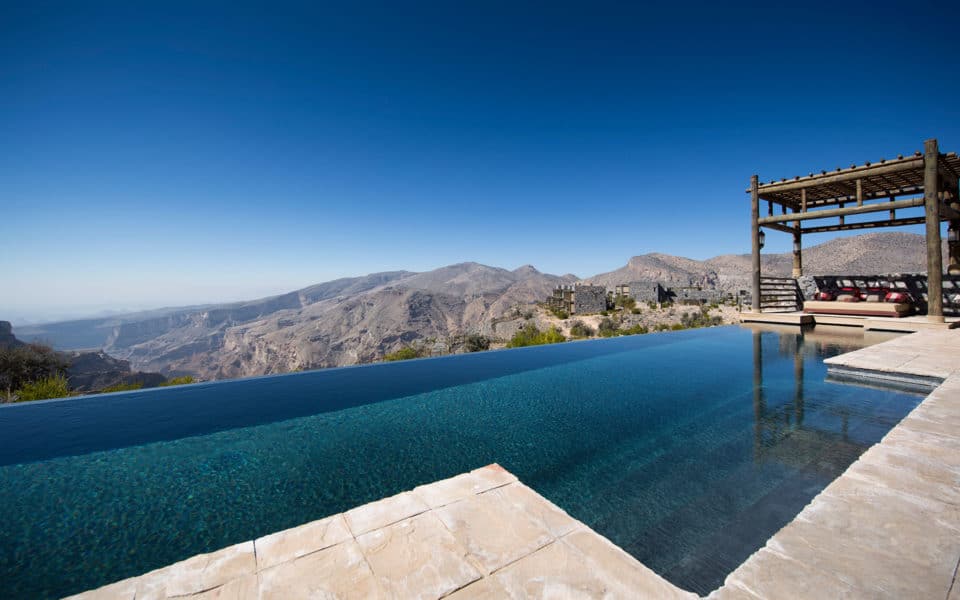
The cliffside hotel that almost nobody expects to find in the Middle East.
The Al Hajar Mountains in inland Oman are not on most travelers’ radar. They should be. The range rises dramatically from the desert floor to peaks above 3,000 metres, and the plateau of Jabal Akhdar — the “Green Mountain” — sits at 2,000 metres above sea level in an area that receives enough rainfall to support roses, pomegranates, and a microclimate completely unlike anything else in the Arabian Peninsula.
Alila Jabal Akhdar is perched at the edge of a canyon that drops approximately 1,000 metres to the valley below. The hotel is not dramatic in the way Santorini is dramatic — there is no turquoise sea, no iconic silhouette. The drama here is geological: raw, ancient, and enormous in a way that makes the human-built resort look genuinely small against its context.
You May Also Like




The architecture responds to the landscape intelligently. Rooms are built from local stone in a palette of ochre and grey that almost disappears into the canyon wall behind. The infinity pool hangs directly over the cliff edge, and the view from that pool — looking across a kilometre of open air to the canyon’s far wall, with the terraced farms of the valley communities far below — is as vertigo-inducing as any view on this list.
The resort is also genuinely interesting as a destination beyond the view. Star-gazing at this altitude, away from light pollution, is exceptional. Rose-water distillation tours with local farmers are available in season. And the drive up from Muscat, though steep and requiring a 4WD vehicle, delivers a sequence of viewpoints that build anticipation in a way that seaplane arrivals and boat transfers cannot.
- Best for: Adventure travelers, photographers, guests looking for something completely off the typical luxury circuit
- Price: From approx. $600–$900/night
- The detail worth knowing: Temperatures at this altitude are significantly cooler than coastal Oman — a genuine selling point in summer when the rest of the country is intensely hot
4. Cape View Clifton — Cape Town, South Africa
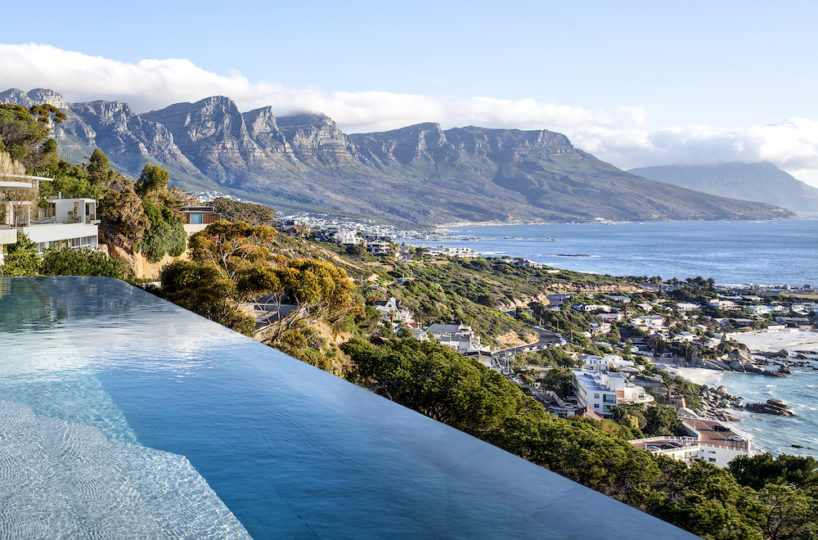
When the cliff faces the Atlantic and Table Mountain at the same time.
Cape Town is one of the world’s most visually extraordinary cities, and Cape View Clifton makes the most of its position above the Clifton beaches — some of the most beautiful urban beaches on earth — with Table Mountain rising behind and the cold South Atlantic stretching ahead.
The property is small by global luxury hotel standards: 12 suites, each with a private terrace and direct Atlantic views. The design is contemporary rather than rustic, with the kind of clean-lined, glass-and-steel aesthetic that prioritizes the window over everything else in the room — which is exactly the right call given what that window looks at.
The pool is the property’s signature feature. Concave in design and positioned at the cliff edge, it creates the impression of the water extending directly to the ocean below — a visual effect that works particularly well at the hour before sunset, when the Atlantic light turns the whole scene a deep amber-gold. Cape Town’s sunsets are reliably extraordinary, and from this vantage point they are particularly so.
Cape Town is also one of the best-value luxury destinations on this list, particularly for European and North American travelers benefiting from the exchange rate. The surrounding area has world-class restaurants, wine country within an hour’s drive, and the opportunity to combine the clifftop hotel experience with genuinely diverse activities — something that pure resort destinations like Santorini cannot always offer.
- Best for: Guests who want dramatic scenery alongside a real city experience, wine enthusiasts, travelers combining South Africa with a safari
- Price: From approx. $400–$700/night — significantly more accessible than most properties on this list
- The detail worth knowing: Cape Town has a distinct high season (November–February) when prices rise and the southerly wind known as the Cape Doctor can be strong — spring (September–October) is often the best balance of weather and pricing
5. Jade Mountain Resort — St. Lucia, Caribbean
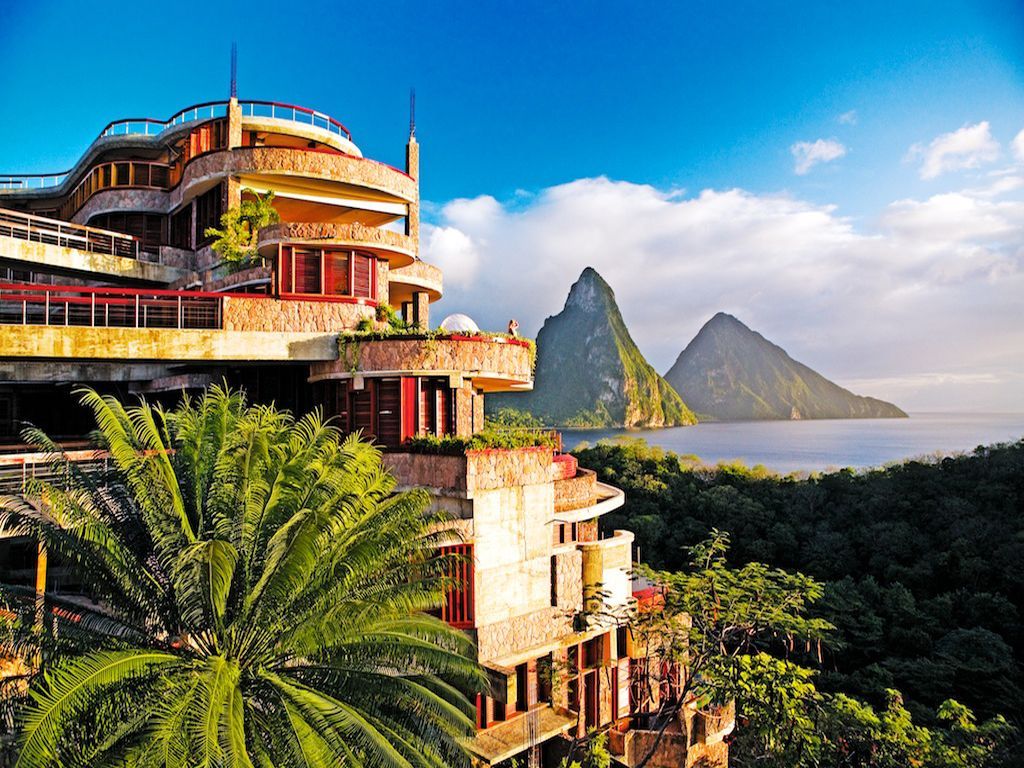
The architect designed his own home and then turned it into a hotel. It shows.
Jade Mountain is the personal project of architect Nick Troubetzkoy, who built the resort on the volcanic hillside above Anse Chastanet, his first St. Lucia property, over decades. The result is something that occupies a category of its own: a series of open-sided suites built into the volcanic rock face with the fourth wall entirely absent — no glass, no railing, just open air and an unobstructed view of the twin Piton peaks rising from the Caribbean Sea below.
The suites are called “sanctuaries” and are organized by their infinity pool size — from smaller “star” sanctuaries to the largest “sky” category with a pool large enough to swim laps. Every sanctuary has this same open-wall feature facing the Pitons and the sea, which means the view is not framed by a window — it simply is the room. Wind, sound, and occasionally rain become part of the interior experience.
That fourth-wall-absent design is the hotel’s defining feature and also its most significant practical consideration. Guests who find the absence of a glass barrier between themselves and a significant drop anxiety-inducing will not enjoy the experience. Those who find it exhilarating — the feeling of being genuinely open to the landscape, not merely observing it through glass — find it transformative.
St. Lucia itself is one of the most naturally beautiful islands in the Caribbean. The combination of volcanic peaks, rainforest, and Caribbean water gives it a landscape richness that beach-only islands can’t match. Jade Mountain’s position on that landscape is essentially perfect.
- Best for: Couples with a genuine appetite for dramatic, open-architecture design; Caribbean travelers who want landscape over beach
- Price: From approx. $1,400–$2,500/night (includes breakfast and dinner)
- The detail worth knowing: The resort is adults-only in the Jade Mountain section; families can stay at the adjacent Anse Chastanet resort with access to shared facilities
6. Jumeirah Port Soller — Mallorca, Spain
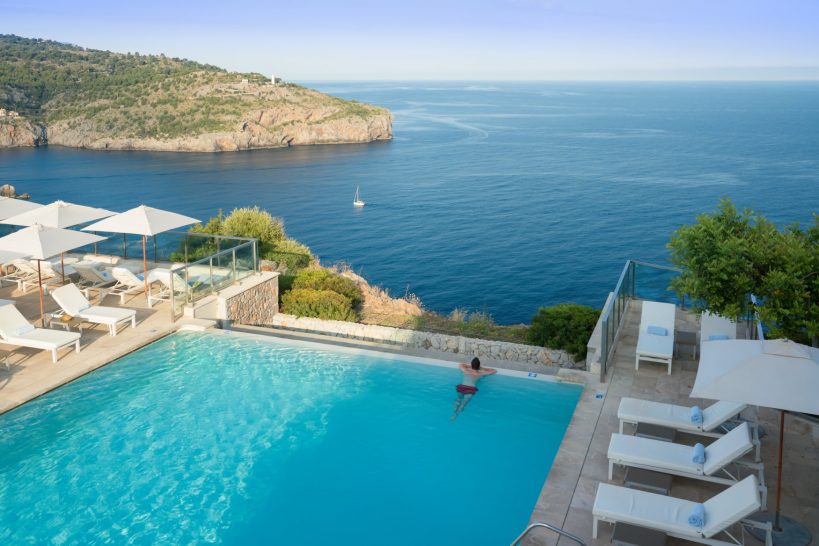
Where the Serra de Tramuntana meets the Mediterranean, and a hotel sits between them.
The northwestern coast of Mallorca looks nothing like the beach resort areas that most people associate with the island. The Serra de Tramuntana — a UNESCO World Heritage mountain range that runs the length of the northwest coast — drops steeply into the Mediterranean in a series of dramatic cliffs and coves. Port Soller is a small fishing village at the base of one of these cliffs, and Jumeirah Port Soller sits above it at a position that puts the mountains behind you and the sea in front.
The hotel has 120 rooms, which makes it larger and more hotel-like than some other properties on this list. But the architecture is well-positioned on the cliff face, with tiered terraces stepping down toward the water and an infinity pool that makes full use of the panoramic setting. The rooms with direct sea views are significantly better than the mountain-facing alternatives — worth the premium.
What Mallorca adds that Greece and Italy cannot always deliver: proximity. For guests traveling from northern Europe, the island is a two-hour flight from most major cities, making this kind of cliffside experience accessible as a four-night trip rather than a ten-day commitment. That accessibility changes the economics of the stay considerably.
- Best for: European travelers seeking a long weekend cliffside experience, couples who want the scenery without the long-haul flight
- Price: From approx. $500–$900/night
- The detail worth knowing: The vintage tram running between Port Soller and Palma is one of the most scenic rail journeys in the Mediterranean and worth building into a day trip from the hotel
7. The Caves — Negril, Jamaica
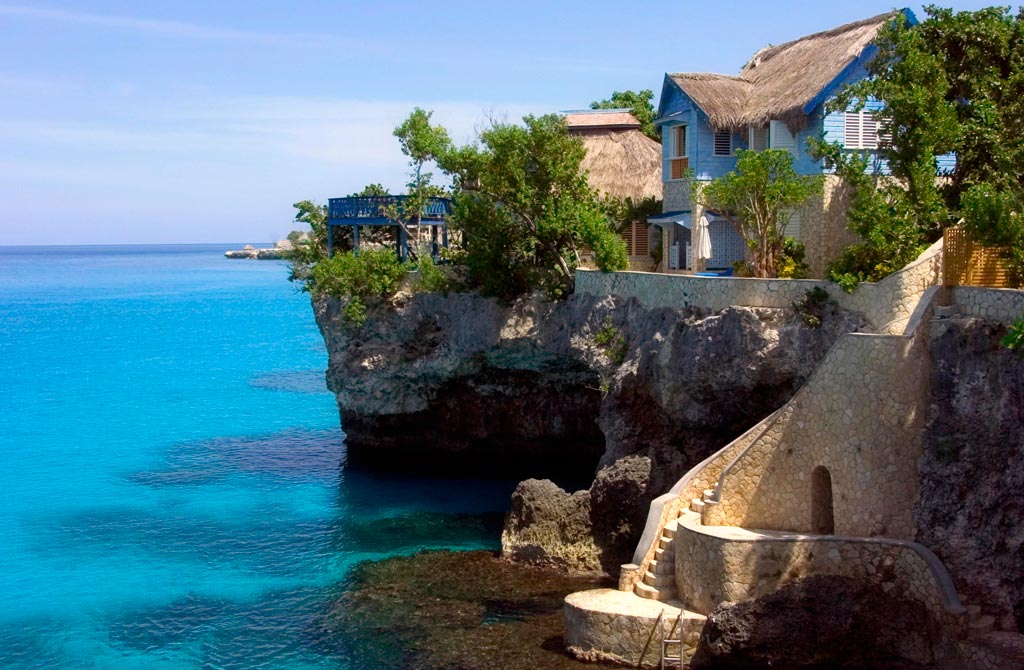
The cliffside hotel that is genuinely unlike anything else on this list.
The Caves is not competing with Santorini or the Amalfi Coast. It knows what it is, which is a small, eccentric, thoroughly Jamaican property carved into limestone cliffs above the Caribbean Sea, with a personality that no amount of luxury budget can manufacture.
There are only 12 cottages, all positioned along and within the cliff. Some have private verandas directly above the water. Several are connected by pathways that pass through the actual limestone caves that give the property its name. There is a cliffside bar lit by torchlight. There is a saltwater jacuzzi carved into the rock. There is a tradition of guests jumping from the cliff into the sea below — supervised, voluntary, and apparently compelling to a significant proportion of visitors.
The accommodation is comfortable rather than grand. The Caves is not a five-star resort in the conventional sense — it is more accurate to describe it as an extremely characterful boutique property that happens to be positioned on one of the most dramatic spots in the Caribbean. Guests who arrive expecting formal luxury leave underwhelmed. Guests who arrive expecting something completely original leave wanting to come back.
- Best for: Travelers who prioritize character and setting over amenities and service polish; those looking for the Caribbean experience with something genuinely distinct
- Price: From approx. $450–$700/night including meals
- The detail worth knowing: All-inclusive meals are part of the package and the food is genuinely good — Jamaican-influenced cuisine that matches the property’s character
8. Post Ranch Inn — Big Sur, California
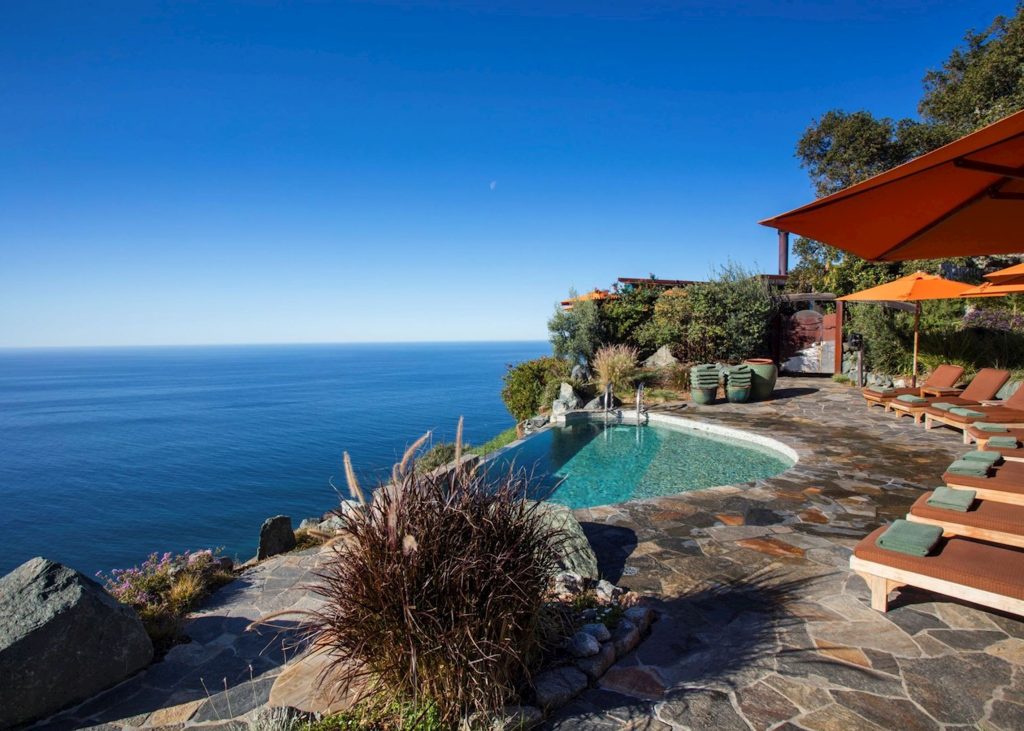
The one that proves not all dramatic cliffs need an ocean view to qualify.
Big Sur is one of the most dramatic stretches of coastline in North America: 90 miles of Pacific Ocean meeting the Santa Lucia Mountains, with Highway 1 threading between them at a height that gives drivers a continuously shifting perspective on the water far below. Post Ranch Inn sits at this junction, on a ridge 1,200 feet above the Pacific, with a relationship to its landscape that is more profound than almost any other property on this list.
The 39 guest houses are organized in categories that respond directly to the terrain. Some are built on stilts above a cliff edge. Some are built into the hillside as earth-sheltered structures that look more like landscape features than buildings. The design, by Mickey Muennig, is the result of a genuine architectural philosophy about how buildings should relate to extraordinary natural environments — not by imposing, but by fitting. The result is a property that looks like it grew from its setting rather than being placed on top of it.
The famous Jade Pool — a cliffside hot spring pool overlooking the Pacific — is the signature experience. Sitting in that pool at night, with the ocean far below and the sky dark enough to show the Milky Way overhead, is the kind of experience that guests describe with unusual emotional weight. It is the same kind of moment that the retractable bedroom roof at Soneva Jani in the Maldives delivers — a point where the boundary between inside and outside dissolves completely.
- Best for: Guests who want the connection between architecture and landscape to be part of the experience; couples on West Coast road trips; photography enthusiasts
- Price: From approx. $1,000–$2,500/night (includes meals)
- The detail worth knowing: Cell phone and work are gently discouraged — the property has no television in rooms and explicitly positions itself around disconnection. That is either deeply appealing or mildly alarming depending on who you are.
9. Cliff House Hotel — Ardmore, Ireland
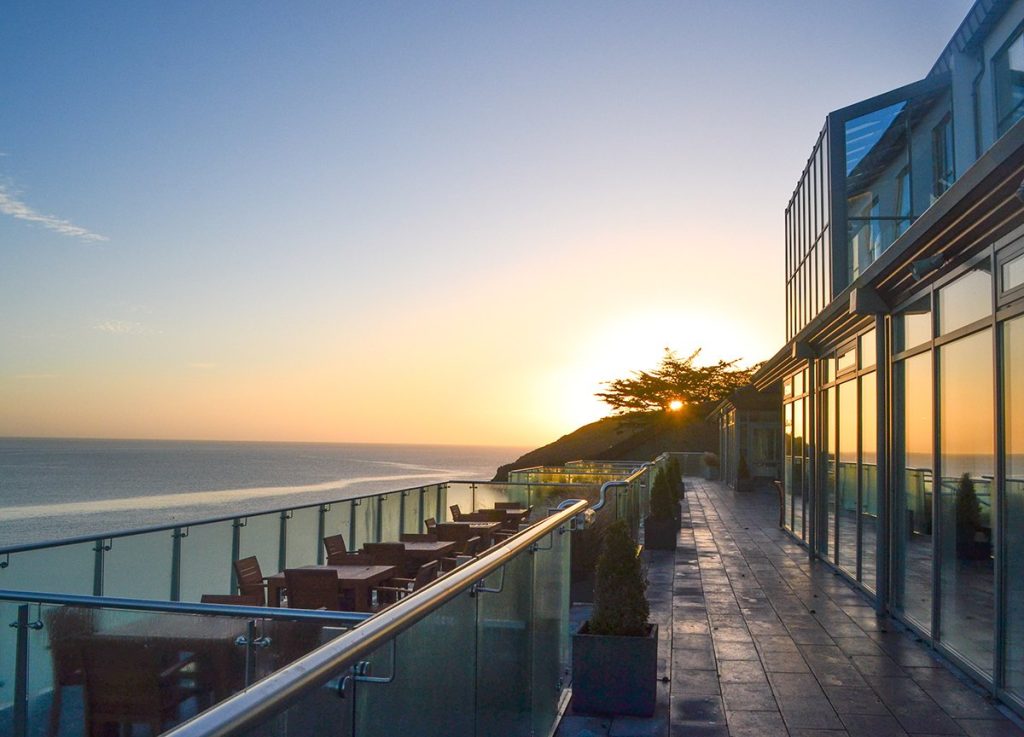
The cliffside hotel that proves the format works in grey skies as well as blue ones.
Every other property on this list involves sunshine, warmth, and the kind of weather that makes dramatic scenery look approachable. Cliff House Hotel in Ardmore, on the south coast of Ireland, is the counterargument: a cliffside hotel that earns its place on this list in a climate of Atlantic wind, dramatic cloud formations, and the specific quality of coastal Irish light that makes the landscape look less like a holiday destination and more like a painting.
The building itself is a striking piece of contemporary architecture — a slate-and-glass structure that clings to the cliff face above Ardmore Bay, with each floor stepping back from the one below to give most rooms an unobstructed sea view. The design is deliberate and modern in a way that contrasts sharply with the ancient round tower and monastic ruins that sit on the headland above. That contrast — new architecture, ancient landscape — is part of what makes the property interesting.
Inside, the hotel is warm, genuinely comfortable, and presided over by a restaurant that takes its locally sourced seafood seriously. The crab, mackerel, and seasonal oysters from the waters directly below the cliff are some of the best things you will eat on an Irish coastal trip, which sets a high bar. The chef’s relationship with local suppliers is one of the property’s real distinguishing features, and it gives the dining experience an EEAT quality that resort restaurants in more famous destinations cannot always match.
- Best for: Guests who actively enjoy dramatic, non-sunny coastal weather; food-focused travelers; couples seeking something genuinely off the well-worn European luxury circuit
- Price: From approx. $350–$600/night — one of the most accessible properties on this list
- The detail worth knowing: Ardmore is a small village with limited outside dining options; the hotel restaurant is the best option in the area, and booking dinner in advance for your arrival night is strongly recommended
10. Bulgari Resort — Bali, Indonesia
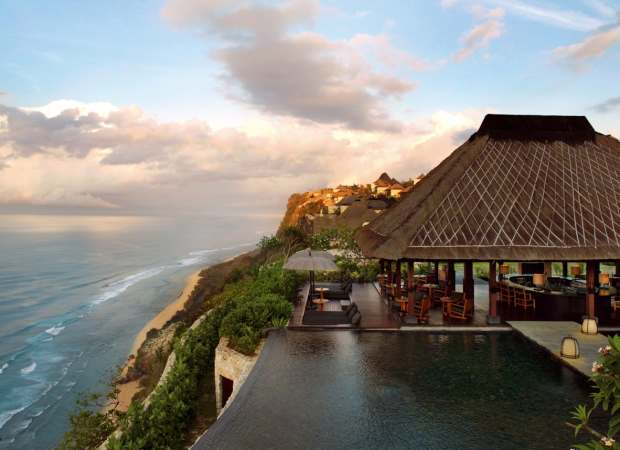
500 feet above the Indian Ocean. A glass elevator. Balinese ritual at every turn.
Bali has no shortage of luxury hotels. But Bulgari Resort, perched on a cliff 500 feet above the Indian Ocean at Uluwatu on the island’s southern Bukit Peninsula, occupies a position that most of Bali’s inland and beach resorts simply cannot match.
The resort is small — 59 villas — and entirely hidden from the road above. Guests descend via a glass-walled lift that travels the full height of the cliff face, opening onto a resort that feels completely separate from the tourist Bali above. The infinity pool at the cliff edge is one of the most photographed in Asia, and the view across the Indian Ocean from that pool — no land visible anywhere, just open blue water to the horizon — is dramatically different from the rice-field and jungle views that define most of Bali’s luxury offering.
The Bulgari brand brings a level of material detail and interior design that sets the villas apart from more naturalistic Bali resorts: marble bathrooms, polished stone floors, Italian furnishings alongside Balinese craftsmanship. It is a combination that could feel incongruous but largely works, because the setting is strong enough to anchor anything built on top of it.
Those who want to combine the Bulgari experience with the broader Bali you probably already know should be aware that the Bukit Peninsula, while stunningly positioned, is geographically separate from the cultural areas of Ubud — covered in detail in our Viceroy Bali review. Budget a day trip if the rice fields and temples are also on your itinerary.
- Best for: Design-conscious travelers; guests who want Bali’s luxury without the inland humidity; anyone who has done the “standard” Bali trip and wants a completely different perspective on the island
- Price: From approx. $1,200–$2,500/night
- The detail worth knowing: Uluwatu is also home to the most famous surf breaks in Bali — the cliffs here are not just scenic but functional for serious surfers, and the evening Kecak fire dance performance at Pura Luhur Uluwatu temple (a 20-minute drive) is one of the most atmospheric cultural experiences in all of Indonesia
What Separates a Good Cliffside Hotel from a Great One
Spending time with this list makes a pattern visible that most hotel guides don’t articulate directly: the best cliffside hotels are not simply hotels that happen to be on cliffs. They are properties where the relationship between the building and the landscape is the result of genuine architectural thinking — where someone decided early on that the cliff was not just a location but a collaborator.
Monastero Santa Rosa works because centuries of monastic construction on that particular cliff face created a relationship between structure and terrain that no contemporary developer could manufacture from scratch. Post Ranch Inn works because an architect spent years understanding the Big Sur landscape before building anything. Jade Mountain works because one person’s obsessive relationship with two volcanic peaks produced something that no hotel brief could have specified.
When you are choosing between properties on a list like this, that is the question worth asking: does this hotel exist in spite of its cliff, or because of it? The ones where the cliff is the reason tend to deliver experiences that photographs — however good those photographs are — consistently underrepresent.
Frequently Asked Questions
Are cliffside hotels safe?
Yes. Every reputable property on this list meets the safety standards required for commercial operation in their respective countries, and all are designed by architects who specifically account for cliff-edge structural requirements. That said, some properties — particularly Jade Mountain with its open-wall design — are not suitable for guests with significant vertigo or heights anxiety. Research the specific layout of any property before booking.
What is the best cliffside hotel in Europe?
That depends on what you are optimizing for. Monastero Santa Rosa on the Amalfi Coast offers the most dramatic combination of history and scenery. Mystique in Santorini delivers the most iconic view. Jumeirah Port Soller in Mallorca is the most accessible from northern Europe. Cliff House Hotel in Ireland is the most distinctive and the best value.
Which cliffside hotels are best for honeymooners?
Mystique Santorini, Jade Mountain St. Lucia, and Monastero Santa Rosa are consistently the top choices for honeymoon bookings — all three offer meaningful seclusion, genuinely dramatic settings, and the kind of atmosphere that frames a significant occasion well. If budget is a consideration, Cliff House Hotel in Ireland and Cape View Clifton in Cape Town both deliver on romance at significantly lower price points.
What is the best time to visit cliffside hotels?
It varies by destination. For Mediterranean properties (Santorini, Amalfi, Mallorca), May–June and September–October offer good weather with fewer crowds and lower rates than peak summer. Oman is best October–April to avoid extreme heat. Bali’s Bukit Peninsula is drier May–September. Big Sur and Cape Town are relatively year-round, with Big Sur most accessible in spring and early summer when fog is less persistent.
Are there cliffside hotels suitable for families?
Several on this list accommodate families. Cape View Clifton, Alila Jabal Akhdar, Jumeirah Port Soller, and Post Ranch Inn all welcome children. Jade Mountain, Monastero Santa Rosa, and Mystique have age restrictions or are primarily couples-focused. The Caves accommodates older children in some room categories. Always confirm directly with the property before booking with young children.
Final Thoughts
A cliff is one of the few things in travel that genuinely stops you in your tracks regardless of how many extraordinary places you’ve been before. It is not the weather or the food or the service. It is the edge — the point where the human world runs out and something much larger takes over.
The hotels on this list have chosen to build at that edge. Some of them pull it off with architectural brilliance. Some with cultural depth. Some simply by getting out of the way and letting the landscape do what landscapes at 1,200 feet above the Pacific or 660 feet above the Tyrrhenian Sea inevitably do.
The experience of being in a room at that edge — waking up to it, walking out onto a terrace and feeling the air differently because there is nothing between you and the distance — is one that stays with travelers long after the trip ends. That is the honest promise these properties make.
Most of them keep it.
Explore more luxury hotel guides on Plishere: