
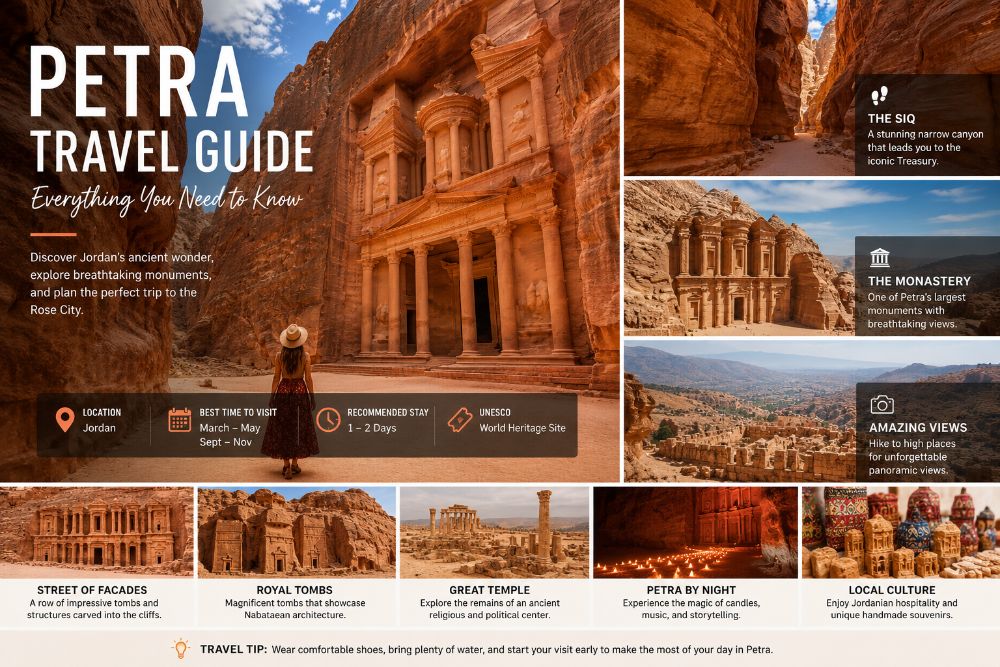
Hidden within the rugged desert landscapes of southern Jordan, Petra is one of the most extraordinary archaeological sites in the world. Often referred to as the Rose City because of its pink sandstone cliffs, Petra attracts millions of visitors each year with its breathtaking architecture, fascinating history, and dramatic natural scenery.
Recognized as a UNESCO World Heritage Site and one of the New Seven Wonders of the World, Petra offers travelers a unique opportunity to step back in time and explore an ancient civilization that thrived more than 2,000 years ago.
Whether you are planning your first trip to Jordan or adding Petra to your travel bucket list, this comprehensive Petra travel guide covers everything you need to know before visiting this remarkable destination.
Where Is Petra?
Petra is located in southern Jordan, approximately 240 kilometers (150 miles) south of Amman, the country’s capital city.
The ancient city lies near the modern town of Wadi Musa, which serves as the main gateway for visitors. Surrounded by mountains and desert landscapes, Petra is one of the most iconic attractions in the Middle East and a highlight of any Jordan itinerary.
Most travelers reach Petra from:
- Amman (3–4 hours by car)
- Aqaba (2 hours by car)
- The Dead Sea (3 hours by car)
The journey itself is spectacular, offering views of Jordan’s dramatic desert scenery along the way.
The Fascinating History of Petra
Petra was established around the 4th century BC by the Nabataeans, an ancient Arab civilization known for their advanced engineering and trade networks.Strategically located along important trade routes connecting Arabia, Egypt, and the Mediterranean, Petra became a thriving commercial center where merchants exchanged spices, silk, incense, and precious goods.
The Nabataeans were master builders and engineers. They carved magnificent structures directly into sandstone cliffs and developed sophisticated water management systems that allowed the city to flourish in the harsh desert environment.
After the Roman Empire annexed the region in AD 106, Petra continued to prosper before gradually declining due to changing trade routes and natural disasters.
For centuries, Petra remained largely unknown to the Western world until Swiss explorer Johann Ludwig Burckhardt rediscovered it in 1812.
Today, Petra stands as one of humanity’s greatest archaeological treasures.
The Treasury: Petra’s Most Famous Landmark
No visit to Petra is complete without seeing The Treasury, also known as Al-Khazneh.
This magnificent sandstone facade stands nearly 40 meters (130 feet) tall and is carved directly into a towering cliff face. Its intricate details, columns, and statues make it one of the most photographed landmarks in the world.The Treasury appears dramatically at the end of the Siq, a narrow canyon that serves as Petra’s main entrance.
For many travelers, the first glimpse of The Treasury emerging from the canyon walls is one of the most unforgettable travel experiences imaginable.
Top Attractions Inside Petra
Although The Treasury receives most of the attention, Petra is much larger than many visitors expect.
The archaeological site covers more than 260 square kilometers and contains hundreds of fascinating monuments.
The Siq
The Siq is a winding sandstone canyon stretching approximately 1.2 kilometers.
Towering cliffs rise on both sides, creating a dramatic pathway that builds anticipation before reaching The Treasury.
Street of Facades
This impressive section features dozens of tombs and monuments carved into colorful rock formations.
You May Also Like




The site provides an excellent introduction to Nabataean architecture.
Royal Tombs
The Royal Tombs are among Petra’s most elaborate burial sites.
Highlights include:
- Urn Tomb
- Silk Tomb
- Corinthian Tomb
- Palace Tomb
These structures showcase the wealth and sophistication of Petra’s ancient inhabitants.
The Monastery (Ad-Deir)
The Monastery is one of Petra’s largest and most spectacular monuments.
Reaching it requires climbing approximately 800 stone steps, but the effort is well worth it.
Many visitors consider The Monastery even more impressive than The Treasury due to its massive scale and stunning mountain views.
Great Temple
The Great Temple complex offers valuable insight into Petra’s political and religious history.
Archaeologists continue to uncover fascinating discoveries throughout the site.
High Place of Sacrifice
For panoramic views of Petra and the surrounding desert landscape, the High Place of Sacrifice is one of the best hiking destinations within the ancient city.
Best Time to Visit Petra
Choosing the right season can greatly enhance your experience.
Spring (March to May)
Spring is widely considered the best time to visit Petra.
Visitors enjoy:
- Comfortable temperatures
- Blooming wildflowers
- Clear skies
- Excellent hiking conditions
Autumn (September to November)
Autumn offers similarly pleasant weather with fewer crowds than peak summer months.
Summer (June to August)
Summer temperatures can exceed 40°C (104°F). If visiting during this period, arrive early in the morning and carry plenty of water.
Winter (December to February)
Winter brings cooler temperatures and occasional rain. While crowds are smaller, some hiking trails may become slippery.
Petra by Night
One of the most magical experiences in Jordan is Petra by Night.
Several evenings each week, the Siq and The Treasury are illuminated by thousands of candles.
Visitors walk through the softly lit canyon before arriving at The Treasury, where traditional Jordanian music and storytelling create an unforgettable atmosphere.
The experience offers a completely different perspective compared to visiting during daylight hours.
Ticket Prices and Entry Information
Most travelers purchase a Jordan Pass, which includes entry to Petra and many other attractions throughout the country.
The Jordan Pass often provides significant savings, especially for visitors planning to explore multiple sites.
Standard entry tickets are also available for:
- One-day visits
- Two-day visits
- Three-day visits
Many travelers find that spending at least two days in Petra allows enough time to explore beyond the main attractions.
Essential Travel Tips for Visiting Petra
Wear Comfortable Walking Shoes
Petra involves extensive walking and hiking.
Expect to walk several kilometers throughout the day.
Arrive Early
The site is significantly quieter during the early morning hours.
Arriving shortly after opening allows for better photographs and a more peaceful experience.
Bring Water and Sun Protection
Jordan’s desert climate can be intense, particularly during warmer months.
Carry:
- Reusable water bottle
- Sunscreen
- Sunglasses
- Hat
Plan for a Full Day
Many first-time visitors underestimate Petra’s size.
A full day is the minimum recommended visit, while two days provide a more complete experience.
Respect Historical Sites
Help preserve Petra by staying on designated paths and avoiding climbing on ancient monuments.
Where to Stay Near Petra
Most visitors stay in Wadi Musa, the town located directly outside Petra’s entrance.
Accommodation options range from budget guesthouses to luxury resorts.
Popular choices include:
- Luxury hotels with mountain views
- Boutique desert lodges
- Mid-range family-friendly hotels
- Affordable backpacker accommodations
Many properties offer rooftop terraces where guests can enjoy stunning sunset views over the surrounding mountains.
Is Petra Worth Visiting?
Absolutely.
Petra is far more than a famous archaeological site—it is a place where history, culture, architecture, and natural beauty come together in a truly remarkable way.
From walking through the narrow Siq and witnessing The Treasury for the first time to climbing mountain trails that reveal breathtaking desert panoramas, Petra delivers unforgettable experiences at every turn.
Whether you are a history enthusiast, adventure traveler, photographer, or cultural explorer, Petra offers something extraordinary.
Final Verdict
Petra remains one of the most awe-inspiring destinations on Earth. Its ancient monuments, fascinating Nabataean history, dramatic desert landscapes, and world-famous architecture make it a must-visit destination for travelers seeking a unique and enriching adventure.
For anyone planning a trip to Jordan, Petra deserves a place at the very top of the itinerary.
Once you step through the Siq and witness the beauty of the Rose City firsthand, it becomes clear why Petra continues to captivate travelers from around the world and remains one of the greatest wonders of human civilization.