
Let’s be honest — Dubai can feel a little overwhelming when you first start planning your trip. The city is massive, the options are endless, and if you don’t know what you’re doing, it’s very easy to overspend, waste time, or accidentally stumble into an uncomfortable situation because you didn’t know the local rules.
We’ve been there. And that’s exactly why we put together this guide.
Whether you’re heading to Dubai for the first time or planning a return visit and want to do it smarter, these 15 essential travel tips cover everything you actually need to know — from the best time to visit and how to get around, to the cultural rules that could save you from an embarrassing (or expensive) situation.
Let’s get into it.
1. Visit Between November and March — Trust Us on This One
Dubai is a desert city, and the heat is no joke. During summer months from June through August, temperatures regularly hit 40°C (104°F) or above, with humidity that makes it feel even worse. Walking between attractions becomes genuinely uncomfortable, and a lot of outdoor activities simply aren’t enjoyable in that kind of heat.
The sweet spot for visiting Dubai is between November and March. During these months, temperatures sit comfortably between 20°C and 28°C — warm, sunny, and genuinely perfect for exploring both indoors and outdoors. Yes, it’s busier during peak season, and yes, hotel prices go up. But the weather difference is so significant that it’s absolutely worth planning around.
If you’re visiting specifically to stay at a resort like Atlantis The Palm where you’ll spend most of your time at the waterpark or beach, the summer months can actually offer great value — just prepare yourself for the heat and plan outdoor activities for early morning or evening.
2. Book Your Burj Khalifa Tickets in Advance
This one catches so many first-time visitors off guard. You arrive in Dubai, decide you want to visit the Burj Khalifa — the world’s tallest building — and find out that same-day tickets are either sold out or cost significantly more than the advance price.
Book your Burj Khalifa tickets online before you travel. The At The Top experience (floors 124 and 125) and the premium At The Top SKY experience (floor 148) both sell out frequently during peak season, and advance booking typically saves you 30-50% compared to walk-up prices.
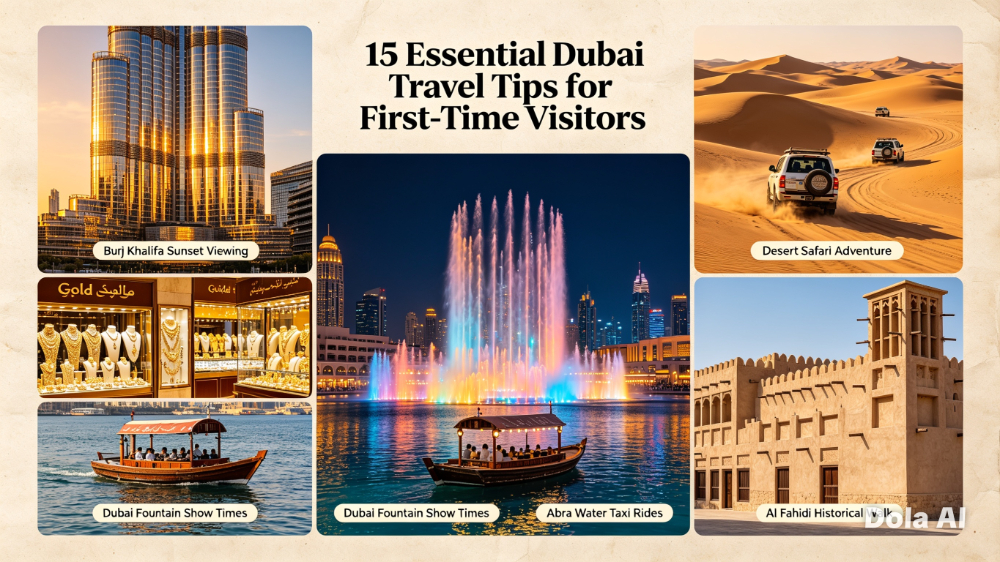
For the best experience, book a sunset time slot. Watching Dubai transform from golden afternoon light to a glittering nighttime cityscape from 124 floors up is genuinely one of the most spectacular views on earth.
3. Dress Modestly in Public Areas
Dubai is an open and welcoming city — but it is also a Muslim city with cultural norms around dress that visitors are expected to respect in public spaces.
What this means practically: shoulders and knees should be covered when you’re in malls, souks, mosques, and public areas. Swimwear is perfectly acceptable at the beach and at hotel pools — but throwing on a cover-up when you leave the pool area is both polite and required in most settings.
This applies to everyone, regardless of gender. The good news is that most major shopping malls have reminders at entrances, and people are generally patient with tourists who are clearly just unaware rather than deliberately disrespectful. But knowing in advance saves everyone the awkwardness.
4. Use the Dubai Metro — It’s Better Than You Think
A lot of visitors default to taxis or ride-share apps for getting around Dubai, and while those are perfectly convenient, the Dubai Metro is genuinely excellent and significantly cheaper for many journeys.
The Red Line covers most of the major tourist areas including Dubai Mall and Burj Khalifa, Dubai Marina, and the Mall of the Emirates. It’s air-conditioned, clean, punctual, and very easy to navigate even if you’ve never used it before.
Pick up a Nol Card (Dubai’s transit card) at any metro station — it works across the metro, buses, and water taxis, and gives you a discounted fare compared to single journey tickets. For getting to Palm Jumeirah, the Palm Monorail connects from the mainland metro network all the way to the crescent.
5. Alcohol Rules Are Specific — Know Them Before You Go
Alcohol is legal in Dubai — but only in specific licensed venues. You can drink at hotels, licensed restaurants, bars, and nightclubs. You cannot drink in public spaces, parks, beaches, or anywhere outside of licensed premises.
Drinking and driving is absolutely zero-tolerance. Even trace amounts of alcohol in your system while driving can result in serious legal consequences. If you plan to drink in the evening, use taxis or ride-share to get back to your hotel — it’s cheap, easy, and completely removes the risk.
During the holy month of Ramadan, some restaurants may not serve alcohol, and eating, drinking, or smoking in public during daylight hours is prohibited out of respect for those who are fasting. If your visit coincides with Ramadan, a little extra awareness goes a long way.
6. Download Careem and Uber Before You Land
Both Careem (the Middle East’s version of Uber, now owned by Uber) and Uber operate in Dubai and are genuinely excellent for getting around when the metro doesn’t quite reach where you’re going. They’re reliable, well-priced, and the drivers are almost universally professional and helpful.
You May Also Like



Download both apps before you arrive and set up your payment method while you still have good connectivity. This saves the frustration of trying to register at the airport after a long flight when all you want to do is get to your hotel.
7. Visit the Dubai Souks — Don’t Just Stick to the Malls
The modern Dubai of Burj Khalifas and luxury malls is spectacular. But if that’s all you see, you’re missing an entire dimension of what makes this city genuinely fascinating.
The Dubai Gold Souk and Spice Souk in Deira are extraordinary. Walking through the Gold Souk — where shop after shop displays astonishing quantities of 18k and 22k gold jewelry in every conceivable form — is an experience unlike anything you’ll find in most cities. The Spice Souk next door fills the air with saffron, frankincense, dried roses, and a hundred other aromas that are pure sensory magic.
Getting there is half the fun too — take the traditional Abra water taxi across Dubai Creek for just a few dirhams, which is itself one of the most atmospheric and genuinely local experiences the city offers.
8. The Desert Safari Is Non-Negotiable
No Dubai trip is complete without a desert safari. If you’ve never experienced driving over enormous sand dunes in a 4×4, watching the sunset paint the desert in extraordinary colors, and then sitting down to a traditional Bedouin camp dinner under the stars, you simply haven’t done Dubai properly.
Book through a reputable operator — there are many to choose from, with varying levels of luxury. Standard desert safaris typically include dune bashing, sandboarding, camel riding, and a buffet dinner with cultural entertainment. Premium and private desert experiences are available for those seeking something more exclusive.
Morning safaris are wonderful for those who prefer a quieter, more peaceful desert experience — watching the dunes at sunrise before the heat builds is something genuinely special.
9. Dubai Mall Is More Than Shopping
Yes, Dubai Mall is the largest shopping mall in the world. But describing it as “just a mall” completely undersells what it actually is.
Inside Dubai Mall you’ll find the Dubai Aquarium and Underwater Zoo — one of the largest suspended aquariums on earth, visible through a massive acrylic window from the mall’s ground floor. There’s also an Olympic-sized ice rink, a VR Park, a cinema complex, and dozens of excellent restaurants. And just outside the mall, the Dubai Fountain — the world’s largest choreographed fountain system — puts on spectacular free shows every evening.
Plan at least half a day here, maybe more if you enjoy shopping. And definitely time your visit to catch the Dubai Fountain show after dark — it’s free, it’s genuinely beautiful, and it’s one of those Dubai moments that actually lives up to the hype.
10. Book Popular Experiences and Restaurants in Advance
Dubai is a city that takes hospitality seriously, and its best restaurants, experiences, and attractions book up quickly — especially during peak season between November and March.
If you have your heart set on dining at Nobu at Atlantis, visiting the observation deck at the Frame, taking a seaplane tour, or staying in a specific suite at your chosen hotel, book as far in advance as possible. Turning up without a reservation at Dubai’s most sought-after venues frequently results in disappointment.
For hotel bookings specifically, direct booking through the hotel’s official website almost always gives you the best rate and most flexible cancellation terms. This is particularly true for resort properties like Atlantis The Palm where early booking can unlock significant savings.
11. Carry Cash — But You Won’t Always Need It
Dubai is an extremely card-friendly city. Major credit and debit cards are accepted almost everywhere — from luxury hotels and restaurants to taxis and most retail stores. You can comfortably navigate most of your trip without needing cash.
That said, there are specific situations where cash in UAE Dirhams is genuinely useful: the Abra water taxis across Dubai Creek, smaller stalls in the traditional souks, tipping (which is always appreciated and typically done in cash), and some smaller local restaurants.
Exchange money at an official exchange bureau rather than at the airport — airport exchange rates are typically significantly worse than city rates. Most malls have dedicated exchange bureaus with competitive rates.
12. Respect the Photography Rules
Dubai is incredibly photogenic, and the temptation to photograph everything is completely understandable. But there are some important guidelines around photography that visitors should know.
Photographing government buildings, airports, military installations, and certain public infrastructure is prohibited. More importantly, photographing local residents — particularly women — without explicit permission is considered deeply disrespectful and can in some circumstances lead to legal issues. Always ask before pointing your camera at people.
Photographing the spectacular skyline, landmarks, desert landscapes, hotel properties, and tourist attractions is absolutely fine and encouraged. Dubai is genuinely one of the most photogenic cities in the world when you know where to point your camera.
13. Don’t Miss Old Dubai
The futuristic skyscrapers and luxury resorts are what put Dubai on the global map. But spending a few hours in Old Dubai — the Al Fahidi Historical Neighbourhood and surrounding Bur Dubai area — reveals a completely different and equally fascinating side of the city.
The Al Fahidi Historical Neighbourhood features beautifully preserved traditional wind-tower architecture, narrow alleyways, and the excellent Dubai Museum, which traces the city’s extraordinary transformation from a small fishing village to a global metropolis in just a few decades.
The contrast between this quiet, historic neighborhood and the glittering modernity of Downtown Dubai just a few kilometers away tells you something profound about what makes this city so uniquely compelling.
14. Stay Hydrated — Seriously
This sounds obvious, but the combination of heat, air conditioning, and the sheer amount of walking involved in exploring Dubai means that dehydration sneaks up on visitors faster than they expect.
Bottled water is widely available and inexpensive throughout Dubai. Carry a bottle with you at all times, particularly when visiting outdoor attractions. Many hotels provide complimentary water in rooms — take advantage of this before heading out each morning.
If you’re visiting during summer, apply high-factor sunscreen regularly and take breaks in air-conditioned spaces throughout the day. The UAE sun at peak hours is genuinely intense, and sunburn in this climate can be severe.
15. Give Yourself More Time Than You Think You Need
This is perhaps the most underrated Dubai travel tip of all. First-time visitors consistently underestimate just how large Dubai is and how long it takes to get between different areas of the city.
Traffic in Dubai can be significant, particularly during morning and evening rush hours, and the distances between major attractions are larger than they might appear on a map. A trip from Downtown Dubai to Palm Jumeirah that looks like it should take 15 minutes can easily take 45 minutes in peak traffic.
Build buffer time into every day. Plan fewer activities than you think you can fit in, and give yourself permission to linger when you find somewhere you love — because in Dubai, you almost certainly will.
Quick Reference: Dubai Travel Tips at a Glance
- Best time to visit: November to March
- Currency: UAE Dirham (AED) — major cards accepted almost everywhere
- Getting around: Dubai Metro, Careem, Uber, taxis
- Dress code: Cover shoulders and knees in public spaces; swimwear at beaches and pools only
- Alcohol: Legal in licensed venues only — never in public spaces
- Photography: Ask permission before photographing people; avoid government buildings
- Language: Arabic is official, but English is spoken almost universally
- Tipping: 10-15% in restaurants is customary; appreciated but not mandatory
- Safety: Dubai is one of the safest cities in the world for tourists
- Must-book in advance: Burj Khalifa, popular restaurants, desert safaris, hotel stays
Where to Stay in Dubai
Your choice of hotel will significantly shape your Dubai experience. The city offers accommodation options across every price point — from boutique hotels in the historic Bur Dubai area to some of the most spectacular luxury resorts on earth.
For the ultimate Dubai resort experience, Atlantis The Palm remains one of the most iconic choices — particularly for families, thanks to the included Aquaventure Waterpark access and the extraordinary Underwater Suites. Read our full review for everything you need to know before booking.
For travelers who want to be centrally located near the Burj Khalifa and Dubai Mall, Downtown Dubai offers excellent hotel options within easy walking distance of the city’s most visited attractions.
FAQ: Travel Tips for Visiting Dubai in 2026
Is Dubai safe for tourists?
Yes, Dubai is consistently ranked as one of the safest cities in the world for tourists. The crime rate is extremely low, the city is well-policed, and tourists are genuinely welcomed and well-catered for throughout the emirate. Standard common-sense travel precautions apply, but Dubai requires no particular security concerns for the vast majority of visitors.
How many days do you need in Dubai?
Most visitors find that four to seven days gives them enough time to experience Dubai’s major highlights without feeling rushed. Four days is enough for a solid introduction to the city’s headline attractions. Seven days or more allows for a more relaxed pace, day trips to Abu Dhabi, and a genuine sense of the city beyond its tourist facade.
Do I need a visa to visit Dubai?
Visa requirements vary significantly depending on your nationality. Citizens of many countries — including the UK, USA, most EU nations, Australia, and many others — receive a visa on arrival or a free visa waiver for stays of 30 to 90 days. Always check the current visa requirements for your specific nationality well in advance of travel, as rules can change.
What is the best area to stay in Dubai?
Downtown Dubai is ideal for first-time visitors who want to be close to the Burj Khalifa, Dubai Mall, and the city’s most iconic sights. Dubai Marina is excellent for those who want a more vibrant, cosmopolitan atmosphere with great restaurants and waterfront access. Palm Jumeirah is the best base for those planning a resort-focused stay.
What should I not do in Dubai?
Avoid public displays of affection, don’t drink alcohol outside of licensed venues, don’t photograph people without permission, don’t use rude or aggressive language in public, and don’t dress inappropriately in public areas. These aren’t particularly onerous restrictions — they’re mostly just about being respectful of the local culture and laws.
Is Dubai expensive?
Dubai has a reputation as an expensive city — and for luxury experiences, it absolutely can be. However, mid-range and budget options exist across accommodation, dining, and transport. The Dubai Metro is very affordable, street food and local restaurants offer excellent value, and many of the city’s most spectacular sights — including the Dubai Fountain, the Gold Souk, and the beaches — are completely free.
Final Thoughts
Dubai is one of those cities that genuinely surprises you — not just with its scale and spectacle, but with its warmth, its contrasts, and the sense that almost anything is possible here.
Plan ahead, respect the local culture, give yourself more time than you think you need, and don’t make the mistake of only seeing the modern Dubai of skyscrapers and luxury malls. The city has layers — and the more of them you explore, the more rewarding the experience becomes.
For more Dubai and luxury travel inspiration, read our full Atlantis The Palm Dubai Review, explore our guide to visiting Petra in Jordan for the perfect Middle East add-on, and check out our collection of the most beautiful underwater hotels in the world for more extraordinary accommodation inspiration.
Dubai is waiting. Go enjoy it.